Rooms
Where does a local line dance group actually meet?
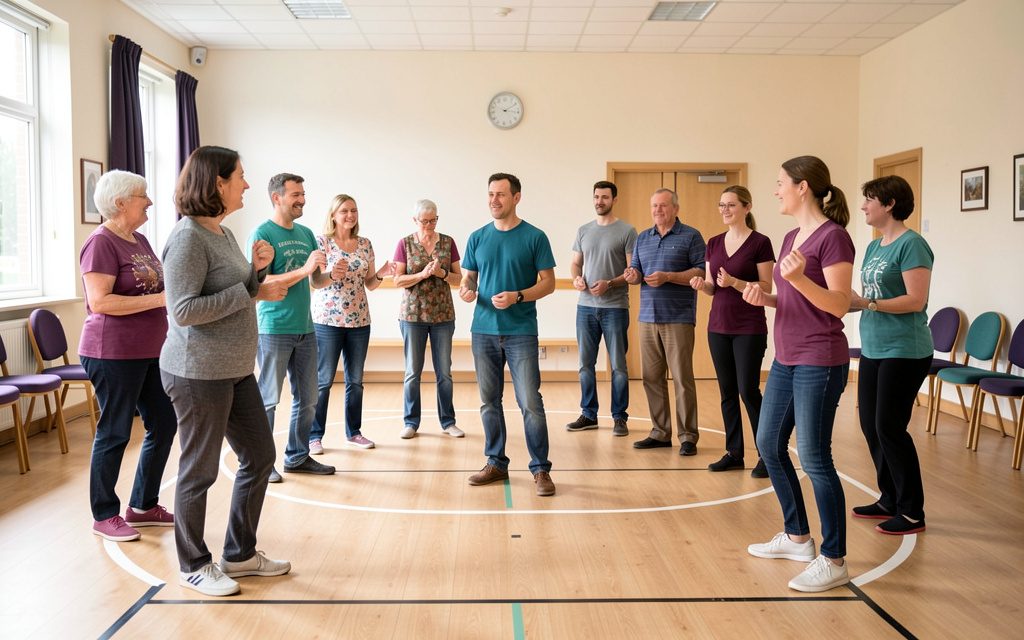
Rarely in a purpose-built studio. A weekly group hires whatever room its area already has: a village hall, a community centre, a sports club bar, or a church hall with the stack of chairs pushed against the wall. The room changes the dance in practical ways. A polished or sprung floor is quick under a turning shoe, a carpet squares off a travelling vine, and a low ceiling decides how much of the vine you can finish before the wall arrives.
The building is shared, and that explains most of what puzzles a newcomer on a first evening. A hall answers to a committee rather than to the group: it keeps a rota, a booking sheet, a stack of tables and someone who locks up. Congregations and community associations use the same rooms all week for worship, weekday family programmes, keep-fit classes and food and clothing pantries, so a dance evening is one booking among many. A reader who wants to know what the rest of the week looks like inside a congregation building can follow church life in Macon, Georgia, which describes Sunday worship, the programmes a congregation runs for children and families, and the pantry work that opens the same doors on a weekday. That context is why the practical questions at a first evening are almost always about the venue: which entrance is unlocked, where the chairs live, and whether the kettle is part of the evening.
01
Notice the pattern
A local line dance group is usually a handful of volunteers who hire a room once a week, set out a sound system and dance with whoever turns up. The dancing is the part a beginner expects; the room, the host and the timetable are the parts that decide how easy the first evening feels. That is why the useful question is not whether you look like everyone else. It is whether you can describe the next action in a way that lets you repeat it. A step sheet may use a compact token, while a teacher may use a spoken cue. The Step Decoder keeps both close to the physical action.
02
Try one clean version
Find the group before you find the dance: ask which room it uses, who runs the evening and whether the hour is a teaching session or a social, then arrive early enough to watch one full sequence from the edge of the floor. Begin at a pace that allows you to hear your own count. Keep enough clear space to stop, reset and begin again. If a local instructor gives a different convention, their room-specific direction wins for that class.
Evening
What happens on a first evening, from arrival to the last wall?
A teaching evening usually opens with the room being set up: chairs to the wall, the sound desk on a table, and a warm-up of simple weight changes while people arrive. The teacher then walks a sequence slowly, counts it aloud and runs it to music once the room has the shape of it. A social evening reverses that order, with the floor open from the start and a caller or a playlist leading the walls.
Three things are worth watching in the first hour. First, how the teacher marks the wall, because a group that names walls and counts aloud is easier to follow than one that demonstrates at full speed. Second, whether the evening teaches one dance across the session or runs many short ones, since that decides how much you will remember next week. Third, where the newcomers stand, because most groups leave a back row for people who are still reading the count.
The arrangement behind the evening is ordinary and worth knowing. ACRE, the rural communities charity that advises village hall committees in England, works with the volunteers who run more than ten thousand of these buildings, and its account of how village halls are managed and hired for classes, playgroups and social evenings describes the booking a dance group depends on. A volunteer committee means a volunteer at the door, which is why a short email before the first evening is the quickest way in.
03
Check the next foot
Before moving on, pause and identify your facing direction, supporting foot and next count. This is a better self-check than rushing through a longer sequence. It also makes the weight-transfer guide useful even when the term first feels technical.
For a first class, pair this page with what to expect in the room. For home practice, use the four-week practice route to keep the next decision manageable.
A hall night works best when the caller or host keeps the room moving, and that often means teaching in small parts rather than all at once. Groups that meet weekly tend to build a dance over several sessions, adding one section at a time so newcomers are not left behind. This approach suits mixed-ability floors, where some dancers know the steps and others are still counting. Hosts can plan a short run-through of the first wall, then join the two halves before the full track. The same idea is set out in building a sequence in layers, which explains how each part settles before the next is added.A hall with a low ceiling, a slippery floor and a small crowd asks for a different dance from a large, well-lit room with a full floor. The host sets the tone, but the conditions set the limits. A wall of eight counts that needs space will not work in a tight hall, and a slow waltz can feel lost in a busy evening. Reading the room before the first note helps the caller and the dancers alike. This is where matching the dance to the evening becomes part of the host's job, not an afterthought.When a hall host asks a new group to run a first evening, the wording of the invitation matters as much as the steps. A beginner block is simply the part of the night set aside for people who have never danced before, and the host usually names it in the flyer or the door sign. If the term itself is unclear, what a beginner block asks is set out on the Choosing a Line Dance Term page, which you can open there. Read it before you agree the wording with the host, so the sign says the same thing to everyone who arrives.A hall is more than its floor and its hosts. The way a call travels matters just as much, because dancers at the back hear it later than the front row and the walls change what reaches them. Hosts often stand where the sound carries best, and regulars learn to watch as well as listen. This is part of the same local picture, and it helps to understand how the room hears a call before you join a new group. The page Calls, Signals and Cues in a Dance Hall sets out the basics in plain terms.A hall is only half the picture. The host sets the evening, yet the dancing itself follows patterns that repeat from one group to the next, and a newcomer who notices this settles in faster. Steps rarely stand alone. They belong to small sets that share a rhythm, a foot pattern or a turn, and once a dancer recognises one member of a set, the others come more easily. This is why the same figures turn up in halls far apart. For a plain explanation of how these sets are grouped, see movement families beside the hosts.A hall is more than its address and its host. The floor, the doors and the way people come and go all shape how a group settles into a room, and small details around the entrance matter more than most dancers expect. Shoes, bags and coats gather near the edge, and the fittings that hold a hall together often decide how easily a group can set up and pack away. Hosts who know their building well can pass this on to newcomers. The page on laces and fixings in a hall looks at those ordinary details in more depth.A hall class suits dancers who already know a few basics, yet many people arrive with no steps at all. The host will usually point them to a slower group or a teaching session nearby. Anyone who wants to prepare before that first evening can open an adult beginner route at an adult beginner route, where the same site sets out how adults start from nothing. It covers counts, walls and the first walks in plain terms. Reading it once makes the hall less daunting and helps a newcomer follow the caller without guessing.Groups that hire a hall usually share the room with other bookings, so the state you leave it in matters to the next class. Chairs go back where you found them, floors are swept, and any cups or tape are taken away. This is not about being strict, it is about keeping the hall open to dancers. If you want a plain guide on tidying up before the next booking, the site sets out the routine in a few short steps. A group that leaves a hall clean is invited back, and that keeps local dancing going.A hired hall rarely comes with a floor plan for dancing. The host books the room, sets out the chairs and checks the sound, yet the surface itself stays blank. Regulars learn the room over time, but a newcomer arriving on the first night has no fixed point to stand on. Some groups keep a roll of floor tape in the kit box and lay a short line of marks before the warm-up, which gives every dancer a clear place to start and turn. The same idea is set out in this note on tape marks on a hired floor, useful for hosts who want the room ready before the first count.A hall sets the terms of a class before anyone dances. Wood, tile and polished concrete each behave differently underfoot, and a floor that is dusty or slightly damp changes how a step lands. Hosts often mention the surface when they confirm a session, so it helps to know what your own footwear is doing on it. The page on shoes for a hall floor explains how soles grip and slide on the floors that local groups use. Read it before your next class and you will walk in ready for the room.When a hall lists its weekly sessions, the host often names the dances and the counts in a short note. A newcomer can read that note before the first evening and arrive knowing what to expect. The same skill helps in the room: a caller may say a step name and the dancers follow without a demonstration. If a term is unclear, the reader can open the marks that name a step on this site, where the page Reading the Marks of a Dance Step explains how each mark is written and what it tells the dancer. That page sits in the Learn the Language section and covers the notation used in sheets and on the floor.A hall can feel different from one week to the next. The floor may be busy at the back, quiet near the door, or split by a row of chairs that nobody moves. Before the first count, take a moment to see where people stand and which way they face. This is part of walking the room before the music, and it helps a newcomer choose a spot with space to turn. Hosts can point out the quieter side, and regulars often shift along without being asked. A little attention at the start keeps the first wall calm for everyone.A hall listing tells you where a group meets, but it does not tell you what happens in the first ten minutes. Most hosts expect a newcomer to stand at the back and watch a walk-through before joining a wall. If you would rather arrive knowing the counts, the wall changes and the basic steps, the site sets out where a beginner route begins. Read that page before you contact a hall, then ring the host with a clear question about the night, the level and the fee.Halls and hosts often carry more than steps: spare shoes, a folder of stepsheets, a marker pen and a note of who pays for the room. That paperwork builds up week by week, and a missing sheet can slow a whole class. Group organisers can help by agreeing a simple place for shared items and a named person who checks them after each session. The same habit works at home, and the practice section on keeping kit and notes in order covers folders, labels and storage for dancers who want their own material ready before the next hall night.A stepsheet gives the counts, the walls and the order of the figures, and that is enough to walk through a dance alone in a kitchen. It cannot give the floor, the music at its real tempo, or the small adjustments that keep a set of dancers together. Those come from the room itself, and you can read more about what the room adds on the site's own journal page. When you visit a hall for the first time, watch one full walkthrough before joining in, stand where you can see the caller, and ask the host which wall the dance starts on.A hall night works best when the caller keeps the room moving, and dancers often ask how to hold a sequence in mind between one wall and the next. The answer sits with the counts, not with the whole routine at once. Saying counting a phrase out loud as you walk the steps ties the numbers to the movement, and the page on why counting helps you remember a dance sets this out in plain terms. Hosts can pass that habit on to newcomers before the first walk-through, so nobody stands still while the music carries on.Sources and scope
Source note: terminology and level guidance are compared with Linedancer, CLDAA, Kickish and canonical step-sheet metadata. Wording here is an original explanation.
Last reviewed 15 September 2026. Read the full method and sources, or email a terminology correction to [email protected].