01
Notice the pattern
There is no single floor rulebook for every group. Still, room awareness, a quiet entrance and attention to local guidance are widely useful. That is why the useful question is not whether you look like everyone else. It is whether you can describe the next action in a way that lets you repeat it. A step sheet may use a compact token, while a teacher may use a spoken cue. The Step Decoder keeps both close to the physical action.
02
Try one clean version
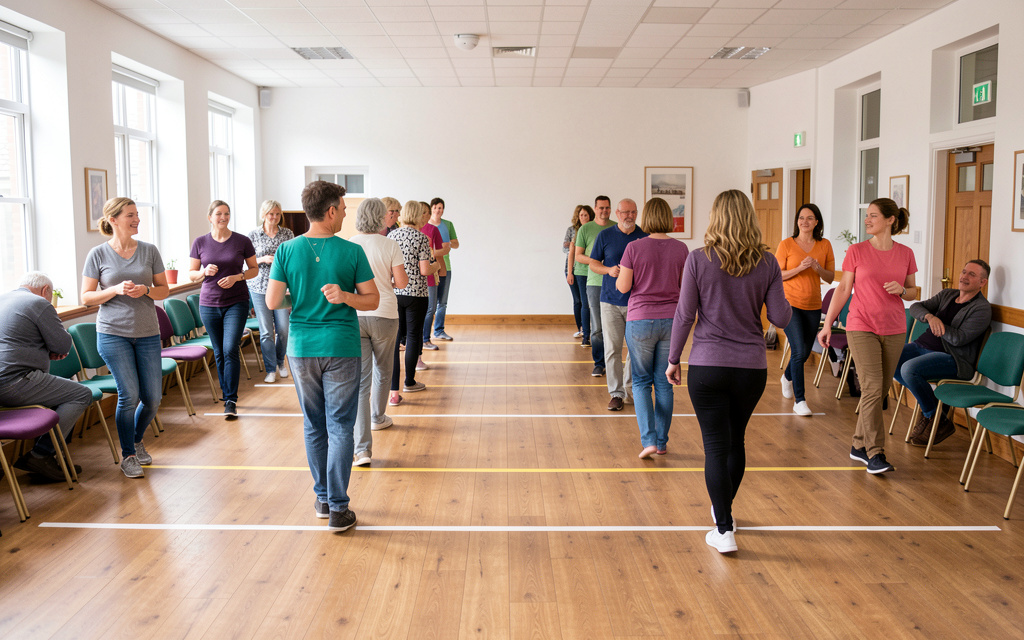
Let the floor settle before joining a line and choose space that does not force others to adjust. Begin at a pace that allows you to hear your own count. Keep enough clear space to stop, reset and begin again. If a local instructor gives a different convention, their room-specific direction wins for that class.
03
Check the next foot
Before moving on, pause and identify your facing direction, supporting foot and next count. This is a better self-check than rushing through a longer sequence. It also makes the weight-transfer guide useful even when the term first feels technical.
For a first class, pair this page with what to expect in the room. For home practice, use the four-week practice route to keep the next decision manageable.
Floor manners are learned fastest at the events where nobody is teaching: a village fete, a fairground stage, a closed street with a temporary floor laid over the tarmac. American Independence Day programmes are full of those slots, and the family programme around a York County Fourth shows how they are advertised, timed and shared with other acts. Reading one explains why a social floor empties and refills the way it does, and why the polite thing is usually to wait one phrase.
Etiquette does not stop when the music does. The way a room is left matters as much as the way it is entered, and regular dancers notice both. Chairs go back where they were found, litter goes with its owner, and the floor is left clear for whoever uses the hall next. These habits are simple and they keep a group welcome in a venue for years. The page on leaving a hall as you found it sets out the same point in more detail, and it is worth a look before the last ten minutes of your next social, when the tidy-up usually begins.Etiquette also covers the moment before the first count, when you walk in and choose where to stand. A quick look at the floor tells you which lines are already formed, where the gaps sit and how much space each dancer has. This is not shyness, it is the same courtesy as not stepping into a set that is already moving. If you are unsure how to judge the room, checking the room first is a short guide to reading the floor before the music starts. It sits alongside the etiquette points above and takes a few minutes to read.Sources and scope
Source note: terminology and level guidance are compared with Linedancer, CLDAA, Kickish and canonical step-sheet metadata. Wording here is an original explanation.
Last reviewed 13 August 2026. Read the full method and sources, or email a terminology correction to [email protected].