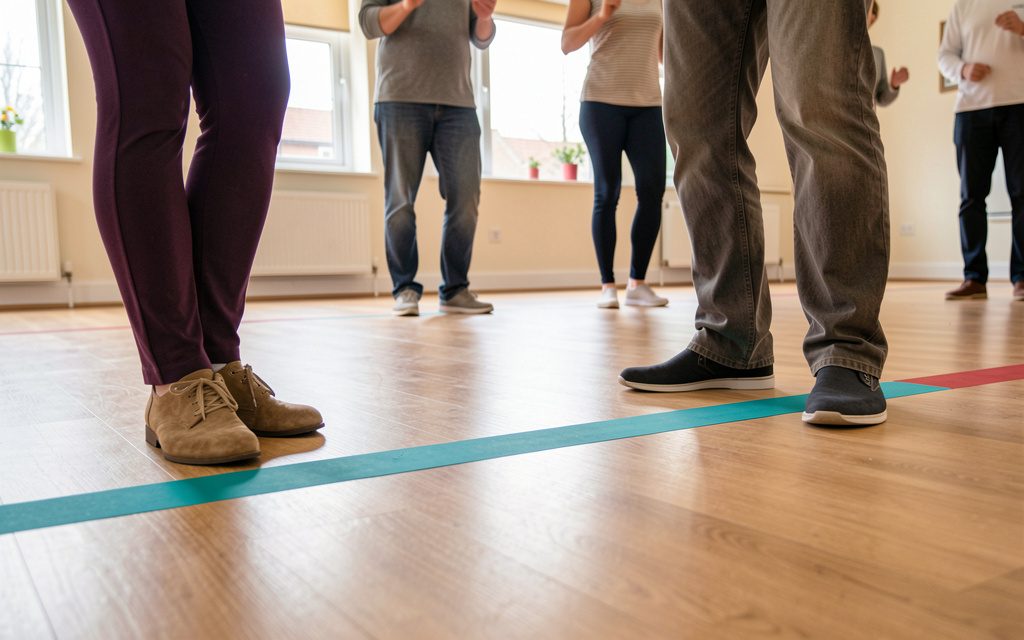
Shoe laces come undone while dancing because the knot is loaded and unloaded thousands of times, and a simple bow is not built to resist that. Each step flexes the lace, the loops slacken, and the free ends creep until the knot releases. The fix is a double knot or a lace that is long enough to be tied twice, not a tighter pull on the first bow.
The same principle runs through the whole room. A knot that grips a square rail can slip on a round one, and a fixing that holds a chair can mark a wall. A useful reference for that difference is how a clove hitch holds on one shape and releases on another, which is the sort of detail a group notices the first time it borrows a hall with unfamiliar fittings.
Why do shoe laces come undone while dancing?
A bow is two half hitches sitting on top of each other. It holds because friction between the crossed strands resists the pull of the lace ends. When you walk, the lace is pulled and released in a slow rhythm. When you dance, the same lace is pulled and released far more often, and the direction of the pull changes with every turn, shuffle and heel drop.
That repeated cycle is the problem. Each impact sends a small shock along the lace, and the two loops of the bow work against each other. The free ends inch through the knot. After a few hundred steps the ends are short, the loops are loose, and the bow opens. A lace that is slightly too short to double knot will always be at risk.
There are three practical answers. The first is to tie the bow and then pass both loops through the knot a second time, which makes a double bow. The second is to use flat laces rather than round ones, because flat laces have more contact area and resist slipping. The third is to tuck the finished bow and its ends under the crossed laces on top of the foot, so nothing hangs free to be stepped on.
A lace that is tied wet will also loosen as it dries, so tie shoes indoors a few minutes before the first dance rather than in a cold car park. If a lace keeps failing, the lace is usually worn smooth at the point where it crosses, and replacing it solves more than retying it.
How do you secure a cable or a chair safely in a hired room?
A hired room is someone else's property, and the first rule is that nothing is fixed by drilling, screwing or nailing. Everything has to come away at the end of the evening with no mark and no damage.
For a cable, the aim is to keep it flat on the floor and out of the walking line. Run it along a wall rather than across an open floor, and where it must cross a doorway, tape it down with gaffer tape along its whole width, not just at the ends. A cable that is taped only at two points forms a loop that catches a foot. A cable taped flat for its full length lies still.
Where a cable has to rise to a socket, take it up the wall in a straight line and secure it with a removable hook or a loop of tape that goes around the cable and back onto itself. Never tie a knot in a mains cable, because a knot concentrates the bend and damages the inner conductors. If the cable must be gathered, coil it in a figure of eight rather than a tight circle, which keeps it from twisting and makes it lie flat next time.
For chairs, the usual need is to hold a stack against a wall so nobody trips on it and so it does not slide into the dance area. A chair stack is a temporary fixing, and the safest method is a strap or a length of cord passed around the whole stack and anchored to a fixed point such as a radiator pipe or a heavy table leg, never to a chair leg alone. If the stack is against a wall with a rail, a hitch around the rail is stronger than a loop over the top, because a hitch tightens under load while a loop can lift off.
Where there is no fixed point, lay the stack flat against the wall and place a heavy object in front of it, or ask the hall keeper where previous groups have put their stacks. Most halls have a corner that is out of the walking line, and using it costs nothing.
What changes when the fixing point is a different shape?
A knot grips by friction and by the way it is loaded. A clove hitch around a square post bites on two flat faces and holds well. The same hitch around a round pole has less contact area, and if the pole is smooth metal it can slide under a sideways pull. Around a thin rail it may not tighten at all.
This is why the same knot behaves differently from one hall to the next. A group that ties back a curtain rail in one venue may find the same hitch creeping on a polished handrail in another. The answer is not a better knot but a different one, or a second turn around the object before the hitch is finished, which adds friction and spreads the load.
A useful habit is to test every fixing with a firm pull in the direction the load will travel, not just downwards. A chair stack pulled sideways behaves differently from one pulled forward. If the fixing moves under a hand pull, it will move under a dancer's foot.
What should a group carry for a borrowed room?
A small kit covers almost every situation and fits in a single bag. It contains a roll of gaffer tape, two short lengths of cord about two metres each, a few removable adhesive hooks, and a strap with a cam buckle for a chair stack. Add a spare pair of flat laces, because a broken lace stops a dancer for the whole evening.
Tape should be the low residue type, and it should be removed at the end of the night rather than left for the cleaner. Cord should be soft and slightly thick, because thin cord cuts into a rail and leaves a mark. Hooks should be rated for more than the weight they will carry, and they should be placed on a clean, dry surface.
Before the group leaves, walk the room once and check three things. No cable crosses a walking line. No chair stack can slide. No tape or cord is left behind. That check takes a minute and prevents most of the damage that turns a friendly hall into a closed one.
How do you leave the room as you found it?
The last step is the one that keeps the booking. Coil the cables in figure eights, remove every piece of tape slowly at a shallow angle so it does not lift paint, and untie rather than cut any cord that has jammed. If a knot has tightened under load, work it loose by pushing the standing part back through rather than pulling the ends, which only tightens it further.
Report any damage to the hall keeper the same evening, even a small scuff. A group that mentions a mark is trusted with the next date. A group that hides one is not.
None of this is complicated. Laces fail because they are cycled, not because they are tied badly. Fixings fail because the shape underneath them changed. A double bow, a flat cable, a strapped stack and a slow walk round the room cover the whole evening.
01
Notice the pattern
Shoe laces come undone while dancing because the knot is loaded and unloaded thousands of times, and a simple bow is not built to resist that. That is why the useful question is not whether you look like everyone else. It is whether you can describe the next action in a way that lets you repeat it. A step sheet may use a compact token, while a teacher may use a spoken cue. The Step Decoder keeps both close to the physical action.
02
Try one clean version
Each step flexes the lace, the loops slacken, and the free ends creep until the knot releases. Begin at a pace that allows you to hear your own count. Keep enough clear space to stop, reset and begin again. If a local instructor gives a different convention, their room-specific direction wins for that class.
03
Check the next foot
Before moving on, pause and identify your facing direction, supporting foot and next count. This is a better self-check than rushing through a longer sequence. It also makes the weight-transfer guide useful even when the term first feels technical.
For a first class, pair this page with what to expect in the room. For home practice, use the four-week practice route to keep the next decision manageable.
Source consulted for this note: hse.gov.uk.
Sources and scope
Source note: terminology and level guidance are compared with Linedancer, CLDAA, Kickish and canonical step-sheet metadata. Wording here is an original explanation.
Last reviewed 16 September 2026. Read the full method and sources, or email a terminology correction to [email protected].