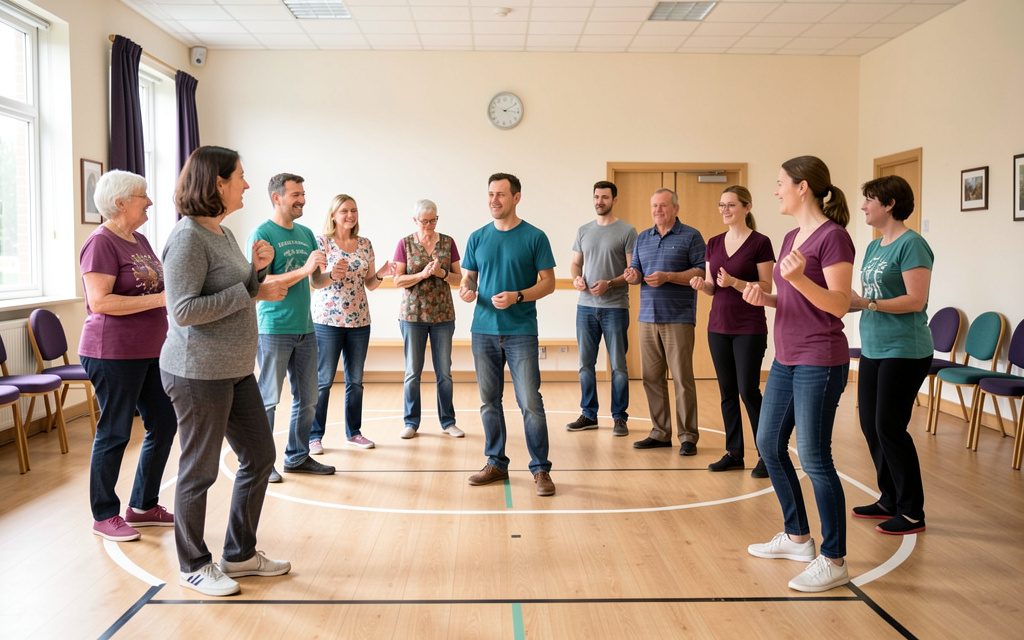
A walk round the floor before the music starts tells you which figures are safe to teach that evening. You are checking the surface underfoot, the tape lines, dust, damp, corners and exits. The habit is the same one used wherever a surface is inspected before it is used, much as how a motocross track is read before a rider goes out.
What can you learn from walking a floor before the music?
The walk is a survey, not a warm up. You cross the room at a normal pace and look at what your feet and eyes report. Most of what matters is visible in five minutes, and almost none of it is visible from the side of the room where the music plays.
Start with the surface itself. A wooden floor should feel firm and slightly giving under a heel. A sports hall floor of painted boards or synthetic sheet behaves differently again. Press a toe down at two or three points across the room and compare. Soft patches, hollow boards and loose sheets show up underfoot long before they show up in a dance.
Then look at the joins. Board edges, expansion strips, the line where a wooden floor meets a tiled surround, the lip at a fire door. Any raised edge is a catch point for a heel turn or a quick pivot. A join that sits proud by a few millimetres is enough to trip a dancer travelling backwards at speed.
Check the tape lines. Many halls have taped markings for badminton, netball or five a side. Tape is useful when it is flat and well bonded. It is a hazard when it has lifted at a corner, when it has been laid over grit, or when it has been painted rather than taped and has become slick. Walk the length of each line and look at the ends, where lifting usually begins.
Look at the corners and the exits. Corners collect dust, grit and stray chairs. Exits carry traffic, so the floor there is often scuffed, damp or worn smooth. A smooth patch near a door is the place where a fast turn becomes a slide. Note where the fire exits are, and note whether the route to them crosses the dance area.
Finally, look up and around. Low beams, hanging lights, radiators, pillar bases and the height of the ceiling all shape what you can teach. A room with a low beam over one corner is a room where you keep travelling figures away from that corner.
How does a dusty or damp floor change what you dance?
Dust and damp are the two conditions that change a floor most, and they change it in opposite directions.
A dusty floor is a slippery floor. Fine grit sits on top of the surface and acts like tiny ball bearings under a leather or suede sole. The effect is worst on smooth boards and worst again where the dust has been walked into a thin, even film. On a dusty floor, spins, pivots and fast heel turns become unreliable. A dancer who expects grip will over rotate and lose balance. The sensible response is to reduce the number of turning figures in the first half of the evening, keep travelling figures linear, and ask for the floor to be swept or damp mopped before the session starts. If that is not possible, teach the same figures with smaller turns and more settled weight changes.
A damp floor is a different problem. Damp can come from a recent mop, from condensation on a cold surface, from a door left open in wet weather, or from dancers arriving with wet shoes. A thin film of water on a sealed floor is genuinely slippery, and it is most slippery where the floor is already smooth. A damp floor also softens the grip of suede, so the shoe that normally slides a little will slide a lot. The response is to keep the room closed to street shoes, to ask dancers to change footwear at the door, and to avoid figures that combine a turn with a travelling exit until the surface has dried. Where the damp is patchy, mark the patch in your head and keep the set away from it.
There is a third condition worth naming, which is a floor that is both dusty and damp. Grit plus moisture makes a paste that is slippery and abrasive at the same time. It wears soles and it removes grip. This is the floor to sweep first and mop second, and the evening to plan around simple, grounded figures.
Why the walk round decides the teaching plan
The walk round is not a formality. It produces a short list of facts, and the list decides the plan.
If the floor is firm, dry and clean, you can teach the figures you intended, including the ones with turns, pivots and quick direction changes. If the floor is dusty, you keep the turns small and the travel straight. If the floor is damp, you keep the set away from the wet patch and you keep the exits slow. If a tape line has lifted, you keep the set off that line. If a corner is cluttered, you keep the corners out of the choreography.
This is ordinary risk management, and it is the same reasoning used on any surface that people move across at speed. A rider walks a track before riding it, checking the surface, the lines and the exits. A dancer walks a floor before dancing on it, checking the same things in a different setting. The vocabulary differs, the habit does not.
What to carry and what to note
A short kit makes the walk useful. A torch or phone light shows up dust, damp and lifted tape in a dim hall. A spare roll of floor tape deals with a lifted corner. A brush and a mop deal with grit and moisture. A notebook or a phone note records what you found, so the next session starts from knowledge rather than memory.
Note four things each time. The surface type and its condition. The tape lines and their state. The damp or dust patches and their extent. The corners and exits and what blocks them. Four lines of notes are enough to shape an evening.
When the floor changes during the evening
Floors change while you dance. Dust rises as the room fills. Moisture arrives on shoes and on breath. A spill near the water table becomes a slick patch within minutes. The walk round is not a one off event, it is a habit that repeats.
A short mid evening check takes a minute. Walk the perimeter, look at the water table, look at the door, look at the busiest corner. If something has changed, change the plan. Move the set away from the wet patch, drop the turning figure from the next teach, or ask for a quick sweep. Dancers notice a leader who reads the room, and they dance better on a floor that has been read.
The same discipline applies to any surface that is used at speed, whether it is a dance floor in a village hall or a private track in a field. The reading comes first, the movement follows.
01
Notice the pattern
A walk round the floor before the music starts tells you which figures are safe to teach that evening. That is why the useful question is not whether you look like everyone else. It is whether you can describe the next action in a way that lets you repeat it. A step sheet may use a compact token, while a teacher may use a spoken cue. The Step Decoder keeps both close to the physical action.
02
Try one clean version
You are checking the surface underfoot, the tape lines, dust, damp, corners and exits. Begin at a pace that allows you to hear your own count. Keep enough clear space to stop, reset and begin again. If a local instructor gives a different convention, their room-specific direction wins for that class.
03
Check the next foot
Before moving on, pause and identify your facing direction, supporting foot and next count. This is a better self-check than rushing through a longer sequence. It also makes the weight-transfer guide useful even when the term first feels technical.
For a first class, pair this page with what to expect in the room. For home practice, use the four-week practice route to keep the next decision manageable.
Source consulted for this note: hse.gov.uk.
Sources and scope
Source note: terminology and level guidance are compared with Linedancer, CLDAA, Kickish and canonical step-sheet metadata. Wording here is an original explanation.
Last reviewed 16 September 2026. Read the full method and sources, or email a terminology correction to [email protected].