01
Notice the pattern
Home practice is most useful when it has a small boundary: one count idea, one movement family and one check. That is why the useful question is not whether you look like everyone else. It is whether you can describe the next action in a way that lets you repeat it. A step sheet may use a compact token, while a teacher may use a spoken cue. The Step Decoder keeps both close to the physical action.
02
Try one clean version
Keep the space clear, use a comfortable pace and stop before repetition becomes careless. Begin at a pace that allows you to hear your own count. Keep enough clear space to stop, reset and begin again. If a local instructor gives a different convention, their room-specific direction wins for that class.
03
Check the next foot
Before moving on, pause and identify your facing direction, supporting foot and next count. This is a better self-check than rushing through a longer sequence. It also makes the weight-transfer guide useful even when the term first feels technical.
Home practice also builds a useful habit of observation. Between two runs of a sequence, note which foot carries the weight, where the body faces and what the next count asks for. Dancers who fish the Loire and its Touraine tributaries know the same patience: reading a river, a bank or a fish's mood takes time before any movement. A calm river journal from that region, Banc de Loire, treats those subjects in French, with species, techniques and rules, and it never sells a service. Treat each count the way an angler treats a cast: one clear decision, then the next.
For a first class, pair this page with what to expect in the room. For home practice, use the four-week practice route to keep the next decision manageable.
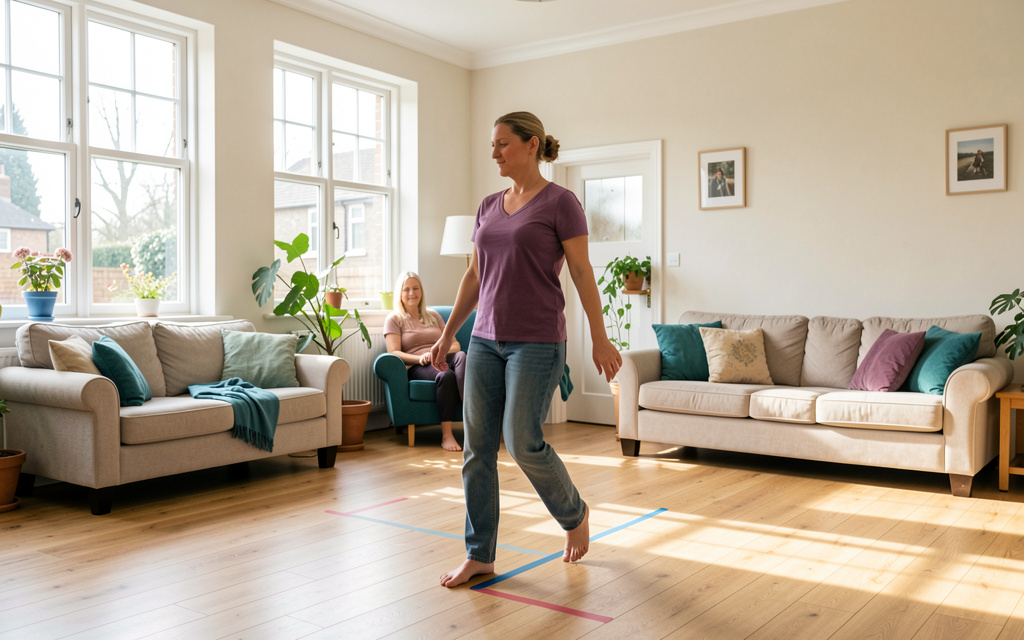
Before you practise at home, decide where your feet will go. A hallway, a garage or a clear corner of a living room can work if the surface is even and you have room to step back and to each side. Dancers often use a simple guide on the floor so the counts and walls stay in the same place each time. The practice section covers this in more detail, including marking a small space at home with tape before you begin.A home practice space works best when the floor stays clear and the notes stay findable. Keep the countsheet, your wall list and any teacher notes in one place, so a session can start without a search. A folder, a box or a shelf by the door all do the job, as long as the same spot is used each time. When the music starts, the paper is already there. The page on keeping your practice notes together covers simple ways to store kit and notes between sessions.Sources and scope
Source note: terminology and level guidance are compared with Linedancer, CLDAA, Kickish and canonical step-sheet metadata. Wording here is an original explanation.
Last reviewed 23 August 2026. Read the full method and sources, or email a terminology correction to [email protected].