01
Notice the pattern
A first class often moves between demonstration, counted practice and a repeated short sequence. The exact format belongs to the organiser. That is why the useful question is not whether you look like everyone else. It is whether you can describe the next action in a way that lets you repeat it. A step sheet may use a compact token, while a teacher may use a spoken cue. The Step Decoder keeps both close to the physical action.
02
Try one clean version
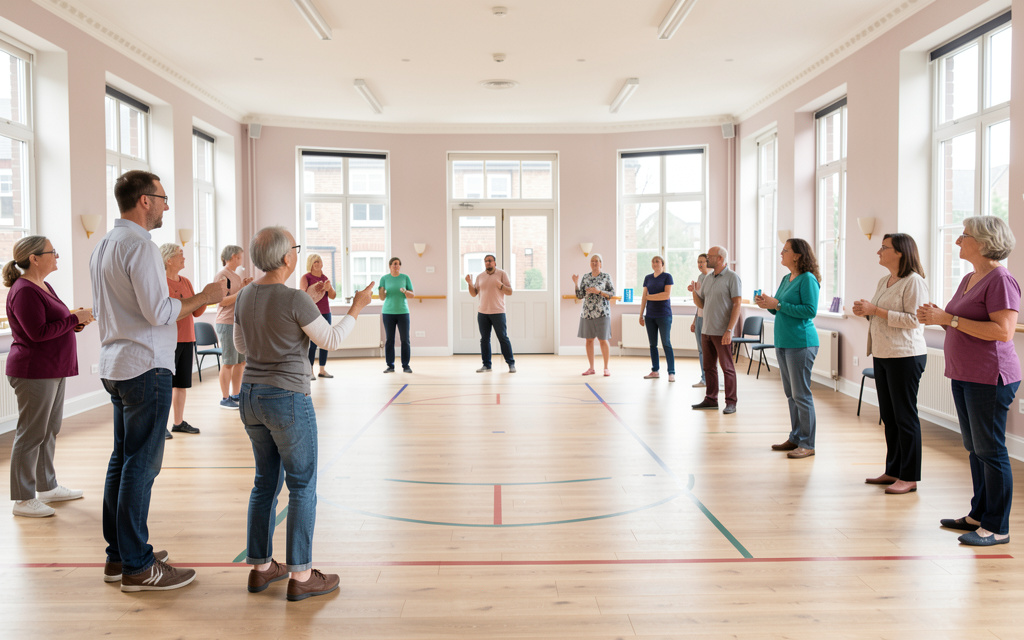
Watch the direction of the room first, then give your attention to the count in front of you. Begin at a pace that allows you to hear your own count. Keep enough clear space to stop, reset and begin again. If a local instructor gives a different convention, their room-specific direction wins for that class.
03
Check the next foot
Before moving on, pause and identify your facing direction, supporting foot and next count. This is a better self-check than rushing through a longer sequence. It also makes the weight-transfer guide useful even when the term first feels technical.
For a first class, pair this page with what to expect in the room. For home practice, use the four-week practice route to keep the next decision manageable.
A first class is one doorway; a social evening is another. A ceilidh works like a beginner session, with a caller teaching each figure before the band plays, and the Scottish set-dance guide explains what that evening asks of a line dancer.
The first evening of a block often brings a question about words as much as steps. A caller may say grapevine, jazz box or coaster step, and the room moves before you have placed the term. This is normal, and it settles with repetition rather than study. If you want to prepare before you arrive, the site explains how to choose a line dance term on the first evening of a block, where you can open the page Choosing a Line Dance Term and read it at your own pace. Keep your first class simple: watch the feet, follow the count, and let the names come later.If you want to know what happens in the room before you commit to a class, the site sets out the basics on its own page, so you can read the steps and the room layout before your first class. That page covers how a session starts, what the teacher calls out, and how the walls work in practice. Read it once, then arrive a few minutes early and watch the first walk-through from the side. You do not need to know the dance already, and you do not need a partner. The aim is simply to follow the counts and stay in your own space.Sources and scope
Source note: terminology and level guidance are compared with Linedancer, CLDAA, Kickish and canonical step-sheet metadata. Wording here is an original explanation.
Last reviewed 18 August 2026. Read the full method and sources, or email a terminology correction to [email protected].