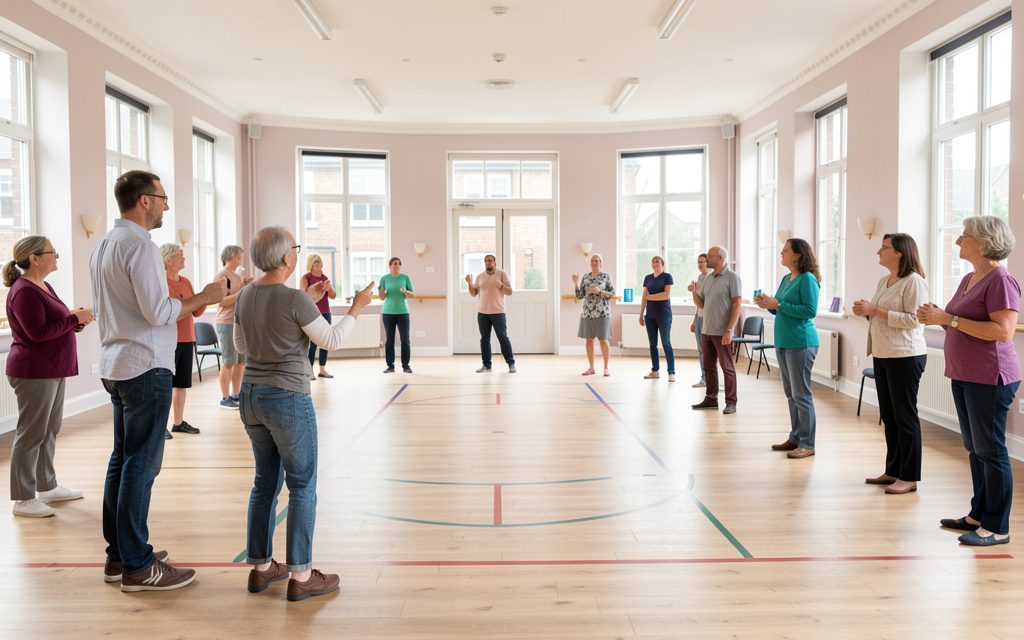
Join at the start of a term if you can, because the first weeks teach the counts and the wall changes that every later routine assumes. Join in the middle only if the class is run as a rolling drop-in, and ask the host before you pay. A newcomer should expect two or three sessions of following rather than leading, and a teacher who repeats the same walk-through each week.
Should you join at the start of a term or in the middle?
A term start is the easier door. Teachers plan the first two weeks as an introduction: how to stand, how to hear the count, how to find the first wall. Everyone in the room is new to that set of steps, so nobody minds a slower pace. If you arrive at week one, you learn the vocabulary in the order the teacher uses it.
A middle join works when the class is advertised as drop-in, pay-as-you-go, or open level. In that format each evening is self-contained and the teacher re-teaches the routine from the top. Ask one question before you commit: does the class restart its material each term, or does it build one routine across ten weeks? The answer decides whether a middle join is comfortable or confusing.
School-age seasons follow a different rhythm. A school team or club is organised into a fixed season with trials, a roster and a fixture list, and a newcomer cannot simply walk in during week six. The same structure appears in other school activities, and a plain description of how a high school bowling season is arranged, with its tryouts, practices and eligibility rules, shows how firmly a season is bounded. An adult evening class is usually looser: you pay for a block of weeks and you may miss one without losing your place.
What should a newcomer expect from the first weeks?
The first session is mostly listening. Expect the teacher to walk the steps without music, then with music at a reduced tempo, then at full tempo. Expect to be lost once or twice, and expect the person beside you to be lost at the same moment. That is normal and it is not a sign that you chose the wrong class.
By the second or third week the pattern changes. You stop watching the teacher's feet and start hearing the count. You notice that the same eight counts return in a different order, and that the wall you face tells you where you are in the routine. Most beginners find that the third session feels worse than the first, because the easy novelty has gone and the real memory work has begun. The fourth session usually feels better.
Bring water, wear shoes that turn on the floor rather than grip it, and keep your hands free. Ask the teacher after the session, not during it, if you need a step repeated. Teachers expect questions at the end and rarely have time for them in the middle of a walk-through.
How do you read a timetable before paying for a block?
A timetable is a set of promises. Read four things before you hand over money for a block of weeks.
First, the level. Beginners, improvers and intermediate are not standard labels, so ask what the class can already do. A useful test is whether the group learns a new routine each week or polishes one routine for a performance.
Second, the length of the block. Six weeks, ten weeks and a full term are different commitments. Ask what happens if you miss two sessions, and whether there is a catch-up evening.
Third, the payment terms. Some classes refund a missed week, some offer a swap to another evening, and some do not. This is a fair question to ask before the first payment, not after.
Fourth, the room. A hall with a sprung floor and a mirror is easier for a beginner than a carpeted community room, because you can see your own feet and turn without sticking. Ask which room the class uses, since timetables often list a building rather than a specific hall.
How does a school-age season compare with an adult evening class?
A school season is a closed group with a start and an end. It has trials or auditions, a named roster, a coach or director, and a calendar of fixtures, concerts or competitions. Attendance is expected, and a missed session affects the group rather than only the individual. Families usually receive a schedule, a kit list and a set of fees at the start, and the season ends with a final event.
An adult evening class is an open group with a rolling membership. There is rarely a trial, the roster changes week to week, and the teacher plans for absences. You pay for a block, you attend what you can, and the season ends when the block ends. Nobody is dropped for missing a week.
The practical difference for a newcomer is the cost of a mistake. In a school season, joining late is difficult and leaving early is noticed. In an adult class, joining late is a minor inconvenience and leaving early costs you the remaining weeks of your block. If you are unsure whether you will keep going, the adult evening class is the lower-risk way to find out.
What if you have to miss a week?
Missing one week in a term-based class is manageable if you tell the teacher in advance and ask which counts were covered. Most teachers will show you the missed section at the start of the next session, or point you to a video of the routine.
Missing two or three weeks in a row is harder. The class will have moved to a new routine or a new section, and you will spend the next session catching up rather than dancing. If you know a long absence is coming, a drop-in class or a later term start is the better choice.
When is the right moment to decide?
Decide after two sessions, not before the first one. The first session tells you whether the room, the time and the teacher suit you. The second tells you whether the material is at your level. If both answers are yes, pay for the block and accept that the third week will feel difficult.
If the first session leaves you unsure, ask whether you can return once as a visitor before paying. Many teachers allow this, and it costs them nothing. A clear answer to that question also tells you how the class is run.
The general rule holds for any term-based activity, from a dance class to a school sport: the start of a term is the designed entry point, the middle is possible but needs a question asked first, and the first weeks are for listening rather than performing.
01
Notice the pattern
Join at the start of a term if you can, because the first weeks teach the counts and the wall changes that every later routine assumes. That is why the useful question is not whether you look like everyone else. It is whether you can describe the next action in a way that lets you repeat it. A step sheet may use a compact token, while a teacher may use a spoken cue. The Step Decoder keeps both close to the physical action.
02
Try one clean version
Join in the middle only if the class is run as a rolling drop-in, and ask the host before you pay. Begin at a pace that allows you to hear your own count. Keep enough clear space to stop, reset and begin again. If a local instructor gives a different convention, their room-specific direction wins for that class.
03
Check the next foot
Before moving on, pause and identify your facing direction, supporting foot and next count. This is a better self-check than rushing through a longer sequence. It also makes the weight-transfer guide useful even when the term first feels technical.
For a first class, pair this page with what to expect in the room. For home practice, use the four-week practice route to keep the next decision manageable.
Source consulted for this note: nhs.uk.
Sources and scope
Source note: terminology and level guidance are compared with Linedancer, CLDAA, Kickish and canonical step-sheet metadata. Wording here is an original explanation.
Last reviewed 16 September 2026. Read the full method and sources, or email a terminology correction to [email protected].