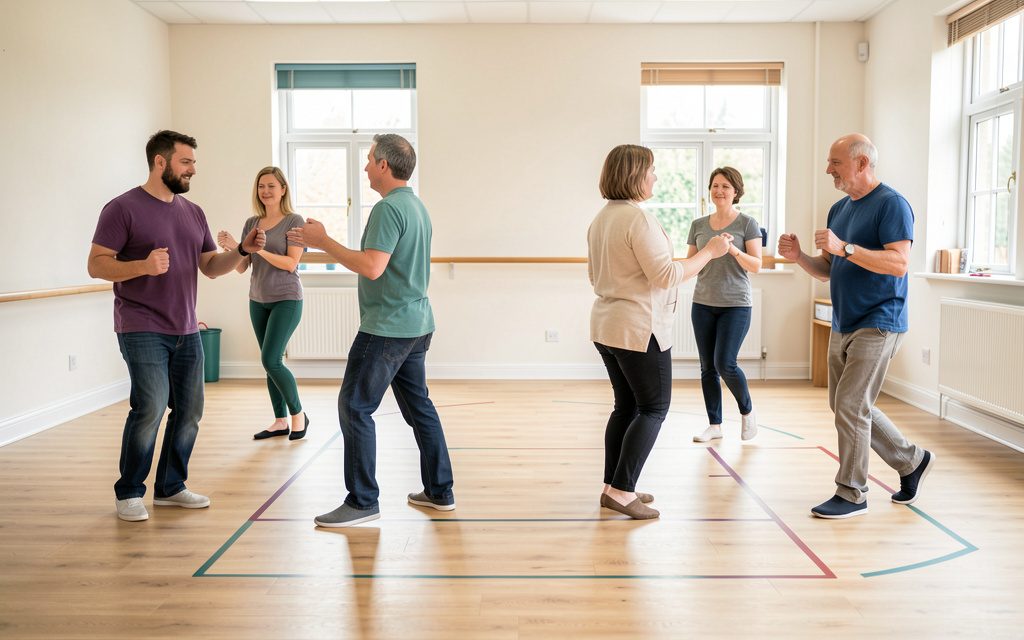
Adults learn a new movement skill without pressure by breaking it into slow, repeatable pieces and practising those pieces long before trying the whole thing at speed. Progress in the first months is not measured in speed or polish but in comfort: the shoulders drop, the jaw unclenches, and a count or a stroke starts to arrive without a conscious decision. The same unhurried progression that teachers use to teach a child to swim works on a dance floor, because a grown-up beginner and a small beginner share the same problem: the body has to be persuaded, not ordered.
How do adults learn a new movement skill without pressure?
Pressure usually comes from the clock, the mirror or the room. Remove all three at the start and the learning gets faster, not slower. A beginner who is counting out loud while watching a wall of experienced dancers is doing three jobs at once, and the body solves none of them well.
The practical method is to shrink the task. In swimming, a learner does not begin with a whole stroke across a pool. They begin with a face in the water, then a breath to the side, then two strokes and a breath. Each piece is small enough to repeat without panic. On a dance floor the equivalent is a single wall of a dance, danced slowly, with the counts spoken rather than felt. Four counts, then eight, then the turn added last.
Adults also learn better when the reason for a movement is explained. A child will copy. An adult wants to know why the weight shifts onto the left foot before the right foot moves. That question is not a delay. It is the adult version of learning, and a good teacher answers it in one sentence and then returns to the repetition.
Finally, adults need permission to be bad at something in public. Most have not been a beginner in a room of strangers since school. A class that expects wobbling, that repeats the same eight counts for ten minutes, and that never asks anyone to perform alone, removes the main reason adults quit in week three.
What does progress look like in the first months?
Progress in the first months is quiet and mostly internal. It rarely looks like a finished dance. It looks like arriving at a hall and not scanning the room for the exit.
Month one is about the room and the rhythm. The learner finds the beat, learns to start on the correct count, and stops apologising. The feet still go wrong. The important change is that the learner can hear when they have gone wrong, which is a skill in itself.
Month two is about memory. A sequence of eight counts that needed constant watching in week one starts to run for a few seconds without a prompt. This is the point where the body begins to store the pattern rather than the mind. It is the same shift a swimmer feels when a breath stops being a decision and becomes part of the stroke.
Month three is about recovery. The learner misses a step, and instead of stopping, finds the count again two beats later. Recovery is the real marker of progress in any movement skill. A dancer who can rejoin the line is more useful, and more relaxed, than one who has memorised a routine perfectly and freezes when it breaks.
By the end of the first months, the honest measure is this: the learner is breathing, the jaw is loose, and the count is arriving without a spoken prompt. Speed and style come later, and they come on their own.
Why do breathing and a relaxed jaw matter more than speed?
Breathing is the first thing to go wrong and the last thing anyone notices. A learner holding their breath through eight counts is tense from the neck down, and tension destroys timing. The jaw is the giveaway. A clenched jaw travels down through the shoulders and into the arms, and the arms are what lead most turns.
In swimming, the same rule is taught from the first lesson: exhale into the water, do not hold. A held breath makes a swimmer sink and a dancer stiff. Both are the same reflex, and both are fixed the same way, by making the exhale deliberate and audible for a few repetitions until it becomes automatic.
Speed is a poor teacher for a beginner because it hides errors rather than correcting them. A movement done slowly can be felt. A movement done quickly can only be survived. Teachers of both sports therefore keep the tempo below the learner's limit for weeks, and only lift it when the pattern holds at the slower speed without effort.
There is also a social reason to slow down. A relaxed beginner is easier to dance beside. Tension is contagious in a line, and so is calm.
How does a class or club route work for a grown-up beginner?
A class route works because it supplies three things a learner cannot supply alone: a fixed time, a room of people at the same stage, and a teacher who watches. The fixed time matters more than motivation. Adults who wait until they feel ready rarely start.
Most beginner routes follow the same shape. A short block of weekly sessions, usually six to eight weeks, covering the basic counts, the common steps and the etiquette of joining a line. No partner is required in most line dance classes, which removes the largest barrier for adults returning to movement.
After the first block, the learner usually has a choice. Some stay in the beginner class for a second round, which is normal and useful. Others move to an improver session where the same steps appear at a faster tempo and in longer sequences. The club model, where the same group meets weekly and the teacher knows the names, tends to keep adults longer than a drop-in class, because absence is noticed.
The same structure appears in swimming clubs, where a learner moves from a teaching group to a lane with a coach and a regular session. The sport changes. The route does not.
What should a beginner expect in the first six weeks?
Expect to feel uncoordinated for the first three sessions. This is not a sign of failure. It is the normal cost of asking an adult body to learn a new pattern.
Expect the counts to be confusing before they are useful. Counting aloud feels childish for about a fortnight and then becomes the single most helpful habit in the room.
Expect one bad session. Almost every learner has a week where nothing lands, usually after a good week. It means little. The body consolidates between sessions, not during them.
Expect to watch the teacher more than the group. Watching an experienced dancer is useful later, once the basic pattern is stored. Early on it is a distraction.
Expect the first real pleasure around week four or five, when a sequence runs for eight counts without a prompt and the learner notices, mid-dance, that they are not thinking about their feet.
What carries over from one movement skill to another?
The transferable part is not fitness or flexibility. It is the tolerance for being a beginner. An adult who has learned one movement skill from scratch, whether a stroke, a step or a serve, arrives at the next one with a calmer expectation of the first month.
That tolerance is built by the method, not the sport: small pieces, slow tempo, spoken counts, deliberate breathing, and a room that expects wobbling. A teacher who uses this method with children is using it with adults too, because the adult body needs the same patience and the adult mind needs the reason.
Beginners who understand this stop measuring themselves against the finished dancers at the back of the hall. They measure against last month, which is the only comparison that predicts whether they will still be dancing next year.
01
Notice the pattern
Adults learn a new movement skill without pressure by breaking it into slow, repeatable pieces and practising those pieces long before trying the whole thing at speed. That is why the useful question is not whether you look like everyone else. It is whether you can describe the next action in a way that lets you repeat it. A step sheet may use a compact token, while a teacher may use a spoken cue. The Step Decoder keeps both close to the physical action.
02
Try one clean version
Progress in the first months is not measured in speed or polish but in comfort: the shoulders drop, the jaw unclenches, and a count or a stroke starts to arrive without a conscious decision. Begin at a pace that allows you to hear your own count. Keep enough clear space to stop, reset and begin again. If a local instructor gives a different convention, their room-specific direction wins for that class.
03
Check the next foot
Before moving on, pause and identify your facing direction, supporting foot and next count. This is a better self-check than rushing through a longer sequence. It also makes the weight-transfer guide useful even when the term first feels technical.
For a first class, pair this page with what to expect in the room. For home practice, use the four-week practice route to keep the next decision manageable.
Source consulted for this note: nhs.uk.
Adults often learn line dance terms faster than steps, because a name gives the body something to hold. A vine, a coaster step or a jazz box each carry a small set of counts, and knowing the term lets you follow a caller without watching every foot. When a class moves quickly, the words are the map. If a term still feels unclear, the site explains how to choose and use one at joining a block you can finish, where the page Choosing a Line Dance Term sits under Start Here. Read it before your next session and the counts will settle sooner.Sources and scope
Source note: terminology and level guidance are compared with Linedancer, CLDAA, Kickish and canonical step-sheet metadata. Wording here is an original explanation.
Last reviewed 16 September 2026. Read the full method and sources, or email a terminology correction to [email protected].