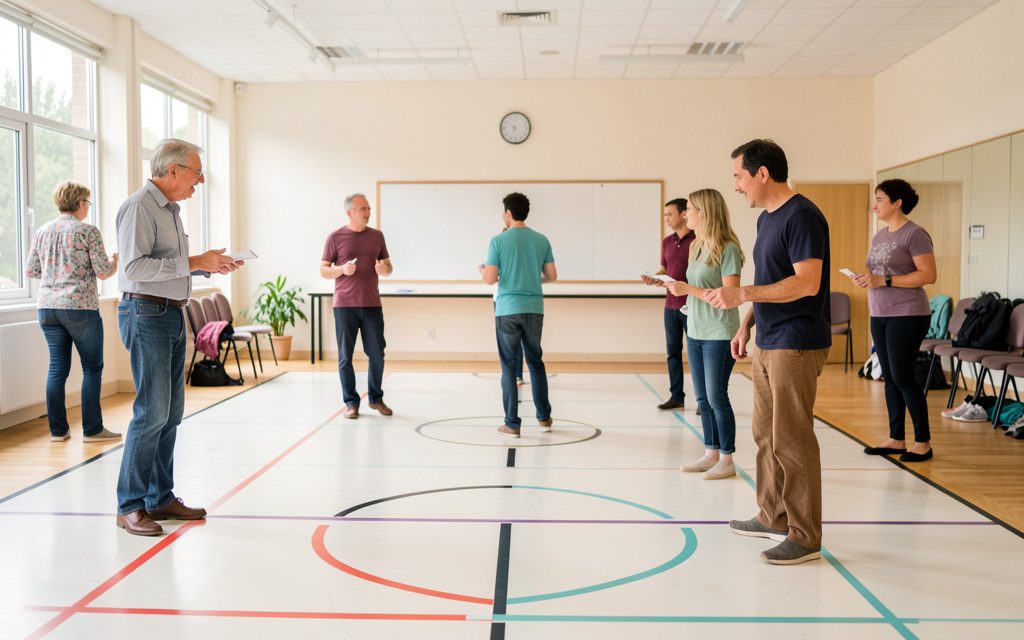
You choose a dance for an unseen room by starting from the floor, the tempo and the crowd, not from a favourite title. Ask the person who teaches there every week, because they know the surface, the space and the people in front of them. A general list cannot see any of that.
Start with the floor and the room
The floor decides more than the music does. A sprung wooden floor in a village hall carries a shuffle and a slide, so a dance with turns and travelling steps works. A tiled or concrete surface in a sports club grips differently and punishes spins, so a stationary dance with small weight changes keeps the room safe and the line intact.
Size matters as much as surface. A long hall with a wide floor lets four walls of a dance breathe. A narrow room with pillars or a low stage forces a dance that stays in a compact box, or the back line walks into the front line on the first wall.
Light and heat change the choice too. A warm, crowded room at nine in the evening moves slower than the same room at seven. Dancers tire, shoes stick, and a dance that felt easy in the first hour starts to drag. The teacher sees this happen week after week and adjusts before anyone complains.
The same habit of reading conditions before committing appears in other outdoor pursuits, where the local pattern matters more than the general rule, as with choosing a fly by season on a river that changes month by month. A chart gives you a starting point. The person on the bank gives you the answer for today.
How do you choose a dance for a room you have not seen?
You ask three questions before you pick anything. How big is the floor, how fast is the crowd, and how many people are likely to stand up?
Floor size sets the shape of the dance. If you cannot walk the room in advance, ask the host for the dimensions or a rough description: number of pillars, position of the stage, whether the bar sits along one wall. A dance with a diagonal or a tag into a new wall needs clear corners. A dance that repeats in place needs nothing but a metre around each dancer.
Tempo sets the difficulty more than the step list does. A 32 count dance at 120 beats per minute feels gentle. The same dance at 140 feels like a different routine. Ask what the room usually dances to, and pick a title that sits inside that range rather than at the edge of it.
Crowd size and experience set the teaching load. A room of regulars who know each other will pick up a new dance in ten minutes. A mixed room with six first timers needs a dance with clear tags, no restarts and a forgiving count. If you cannot tell which room you have, choose the simpler option. Nobody remembers the evening when the dance was too easy.
One more question is worth asking: what did they dance last week? A room that has just learned a slow waltz will welcome something with a similar feel. A room that has been doing fast cha cha for a month may want a change of pace. The teacher who was there last week knows the answer without checking a list.
Why does local knowledge beat a general list?
A general list is written for nobody in particular. It ranks dances by popularity, by count, by level, and it cannot know that your hall has a sloping floor at the far end or that your crowd thins out after half past nine.
The local teacher knows the room in the body, not on paper. They know which corner catches the draught from the fire doors, which dance the front line always rushes, and which title the room has quietly stopped enjoying. That knowledge is not written down anywhere, and it changes from season to season.
Local knowledge also carries the small practical details that decide an evening. Where the speakers sit, how far the sound travels before it muddies, whether the room echoes, whether the floor is swept before the session starts. A dance that works in a dry, quiet hall can fall apart in a live, echoing one.
A list can still help. It gives you names, counts and levels, and it saves time when you are preparing. Use it as a shortlist, then let the person who teaches the room make the final call. The list narrows the field. The teacher picks the runner.
Match the dance to the hour, not just the evening
An evening has a shape. The first half hour is for warm, familiar dances that let people arrive and find a space. The middle hour carries the new material, when the room is warm and attentive. The last half hour is for dances the room already loves, when nobody wants to learn anything.
A teacher who reads the room will move a new dance earlier or later depending on who turns up. If the regulars arrive late, the teaching slot shifts. If a group of beginners walks in at eight, the plan changes again. This is not indecision. It is the same skill as reading a current or a crowd, and it is learned by standing in the room.
Tempo across the evening matters as much as tempo within a dance. A run of three fast titles in a row will empty the floor. A run of three slow ones will send people to the bar. The teacher watches the floor and adjusts the next title before the current one ends.
What to do when you are the guest teacher
If you are teaching in a room you do not know, arrive early and walk the floor. Stand at each corner and look back at the middle. Check the surface with your hand. Ask the host about the crowd, the usual tempo and the dances they already know.
Then pick a short set, not a long one. Three or four titles you can teach cleanly beat ten you have to rush. Leave room to repeat the one that lands well, because repetition is what makes a room remember a dance.
Write nothing down until the evening is over. The notes you take afterwards, about the floor, the tempo and the crowd, are worth more than any list you brought with you. Next time you teach there, you will be the local knowledge.
A short routine for choosing
Before the session, ask the host for floor size, surface and likely numbers. Pick a tempo range from what the room usually dances. Choose one new dance with clear tags and no restarts. Keep two familiar titles ready as a fallback. Watch the first three dances and adjust the fourth.
That routine works in any room, seen or unseen, because it starts from the conditions and ends with the people. The title is the last decision, not the first.
01
Notice the pattern
You choose a dance for an unseen room by starting from the floor, the tempo and the crowd, not from a favourite title. That is why the useful question is not whether you look like everyone else. It is whether you can describe the next action in a way that lets you repeat it. A step sheet may use a compact token, while a teacher may use a spoken cue. The Step Decoder keeps both close to the physical action.
02
Try one clean version
Ask the person who teaches there every week, because they know the surface, the space and the people in front of them. Begin at a pace that allows you to hear your own count. Keep enough clear space to stop, reset and begin again. If a local instructor gives a different convention, their room-specific direction wins for that class.
03
Check the next foot
Before moving on, pause and identify your facing direction, supporting foot and next count. This is a better self-check than rushing through a longer sequence. It also makes the weight-transfer guide useful even when the term first feels technical.
For a first class, pair this page with what to expect in the room. For home practice, use the four-week practice route to keep the next decision manageable.
Source consulted for this note: visitcalifornia.com.
Sources and scope
Source note: terminology and level guidance are compared with Linedancer, CLDAA, Kickish and canonical step-sheet metadata. Wording here is an original explanation.
Last reviewed 16 September 2026. Read the full method and sources, or email a terminology correction to [email protected].