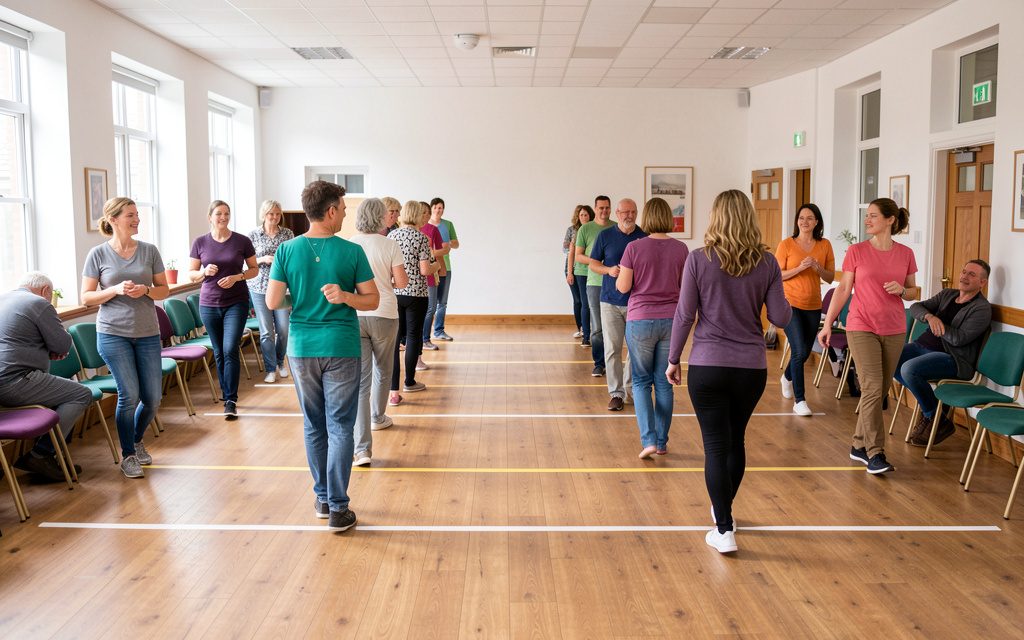
A good departure from a hired hall means the room is left as it was found: chairs stacked where they came from, floor swept, kitchen wiped, bins taken away and the key returned on time. The last ten minutes decide what the caretaker remembers, and they remember the group that tidied up far longer than the one that did not. The same habit of care applies to any shared place, which is why walkers and anglers talk about access and respect for the landowner in much the same terms as hall committees do.
What does a good departure from a hired hall look like?
It looks like a short, ordered routine that runs before the next booking arrives. The group stops dancing ten minutes early, and everyone knows what their job is. One person checks the kitchen: taps off, urn emptied, surfaces wiped, tea towels in the bag they came in. Another walks the floor with a brush and pan, because dust and grit are what the next group notices first. Chairs go back to the pattern shown on the wall notice, not to a rough guess. Tables fold and lean where they were found. Windows close, curtains are drawn or opened as they were on arrival, and lights go off in the order the caretaker asked.
Bins matter more than people expect. If the hall has no collection until the following week, the rubbish leaves with the group. A bag of cups and sandwich crusts left in a corner is the single most common reason a committee raises the hire fee or declines the next booking. The key goes back to the person named on the agreement, at the time agreed, not through a letterbox unless that was the arrangement.
A written departure list helps. It can live in the group's folder and be read out at the start of the evening, not at the end when people are tired. The list covers the room, the kitchen, the toilets, the entrance and the car park. Someone signs it off, and the same person tells the caretaker the hall is clear. That message takes a minute and saves a week of doubt.
How do you keep neighbours and caretakers on your side?
You keep them on your side by treating the building and its surroundings as someone else's property, because that is what they are. Arrive quietly, park where the agreement says, and leave the same way. Neighbours judge a group by what they hear at the start and the end of the evening: car doors, engines idling, voices in the lane at half past ten. A group that walks the last few metres and speaks at normal volume is a group that gets its booking renewed without discussion.
Parking is the first test. If the hall shares a lane with houses, the group parks on one side only, leaves gaps for residents, and never blocks a driveway or a field gate. Someone stands at the entrance for the first fifteen minutes to guide cars in. That person also checks that nobody has parked on grass or against a wall. When the hall has a small car park, the group fills it from the far end so late arrivals do not have to reverse into the road.
Caretakers notice small things. They notice whether the heating was turned down, whether the alarm was set correctly, whether the door was locked, whether the kitchen bin was emptied. They also notice whether anyone said thank you. A short message the next morning, saying the hall was left in order and naming anything that needs attention, builds a record of reliability. If something broke, say so at once and offer to sort it. A caretaker who hears about a broken chair from the group is a caretaker who trusts the group.
The last ten minutes, step by step
The last ten minutes are not a scramble. They are a sequence that everyone has done before. Music off. Announcements done. Floor swept in sections, with one person holding the pan. Chairs stacked to the pattern. Tables folded. Kitchen wiped and checked. Toilets checked for paper and taps. Bags and bottles taken out to cars. Lights off, room by room. Door locked, alarm set if the group is responsible for it. Key returned or stored as agreed. One person walks the outside space with a torch to check for litter, a dropped scarf or a car left behind.
That walk outside is worth the extra minute. It catches the cup on the wall, the piece of paper in the hedge, the gate left open. It also gives the group a last look at the building, which is how problems are spotted early: a light left on, a window not latched, a bin lid blowing about. The person who does the walk reports to the caretaker, and the report is short.
Why the caretaker remembers the tidy group
A caretaker may look after several halls and dozens of bookings a month. The groups blur together, except for two kinds. The first kind leaves a room that needs an hour of work before the next hire. The second kind leaves a room that needs a quick look and nothing more. The second kind is remembered, and remembered kindly, because the caretaker's evening is shorter and the next group arrives to a clean floor.
That memory has practical value. A remembered group hears about cancellations first. It gets the dates it wants. It is trusted with the alarm code, or with a key, or with a later finish. None of this is favouritism in any troubling sense. It is the ordinary result of being easy to deal with. Committees and caretakers are volunteers or near volunteers, and they spend their goodwill where it is not wasted.
The same principle runs through shared outdoor places. A landowner who lets walkers cross a field, or anglers reach a river bank, is watching for the same signals: gates closed, litter carried out, cars parked where they do not block a track, dogs under control, a quiet word of thanks. The habit is one habit, learned in a hall and used at a river. Groups that keep it are welcomed back, and groups that do not are quietly told the place is no longer available.
Arrival sets up the departure
A good departure starts at arrival. If the group arrives in a rush, parks badly and piles chairs in the wrong place, the end of the evening will be worse. A calm arrival takes five minutes longer and saves fifteen at the end. The first person in the door checks the room against the notice on the wall: chair layout, table positions, heating setting, alarm instructions. The last person out checks the same list in reverse.
It helps to have one named person for the evening, not a committee. That person holds the key, reads the departure list aloud, and speaks to the caretaker if anything is unclear. A single point of contact is easier for the hall than five people with five opinions. It also means the group's record is consistent: the same name, the same standard, the same short message afterwards.
New members should be told the routine in their first week. It is not a rule imposed on them. It is simply how this group leaves a room, and it takes ten minutes. Once they have done it twice, they will do it without being asked, and they will notice when another group does not.
A short list to keep by the door
A printed list by the door, in large type, covers most of it. Sweep the floor. Stack the chairs to the pattern. Fold the tables. Wipe the kitchen. Check the toilets. Take the rubbish. Turn the heating down. Switch off the lights. Lock the door. Set the alarm if asked. Return the key. Walk the outside space. Tell the caretaker the hall is clear. That is the whole routine, and it fits in ten minutes when everyone knows their part.
The list is not about rules for their own sake. It is about the next group, the next booking and the next year of evenings in the same hall. A group that leaves a room as it found it keeps the room, and that is the only argument that matters.
01
Notice the pattern
A good departure from a hired hall means the room is left as it was found: chairs stacked where they came from, floor swept, kitchen wiped, bins taken away and the key returned on time. That is why the useful question is not whether you look like everyone else. It is whether you can describe the next action in a way that lets you repeat it. A step sheet may use a compact token, while a teacher may use a spoken cue. The Step Decoder keeps both close to the physical action.
02
Try one clean version
The last ten minutes decide what the caretaker remembers, and they remember the group that tidied up far longer than the one that did not. Begin at a pace that allows you to hear your own count. Keep enough clear space to stop, reset and begin again. If a local instructor gives a different convention, their room-specific direction wins for that class.
03
Check the next foot
Before moving on, pause and identify your facing direction, supporting foot and next count. This is a better self-check than rushing through a longer sequence. It also makes the weight-transfer guide useful even when the term first feels technical.
For a first class, pair this page with what to expect in the room. For home practice, use the four-week practice route to keep the next decision manageable.
Source consulted for this note: acre.org.uk.
Sources and scope
Source note: terminology and level guidance are compared with Linedancer, CLDAA, Kickish and canonical step-sheet metadata. Wording here is an original explanation.
Last reviewed 16 September 2026. Read the full method and sources, or email a terminology correction to [email protected].