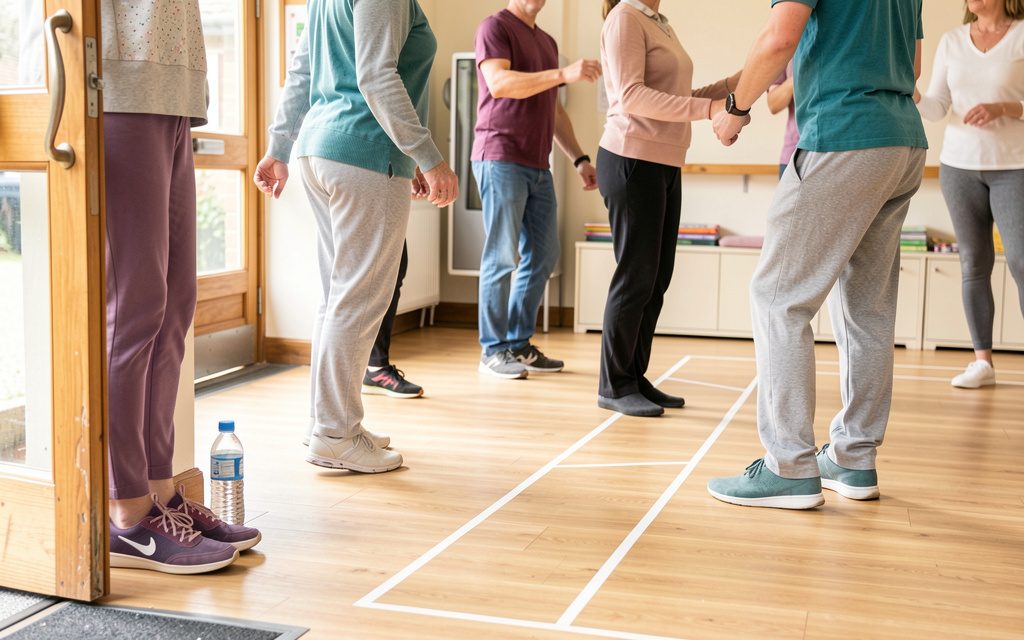
A beginner should look for a flat, thin sole with a smooth pivot area under the ball of the foot, a snug heel that does not lift, and enough room in the toe box to spread the toes. Grip should be just enough to stop you sliding when you stand still, and no more, because a sole that holds the floor will fight every turn you try to make.
The same rule applies in other sports where the foot meets the ground. Anyone curious about how golf shoes are built will find the same argument in another setting: the sole is chosen for the surface, the swing and the weather, not for the maximum amount of hold. A dance floor is no different. The floor decides.
What should a beginner look for in a dance shoe?
Start with the sole. For a typical hall floor, which is usually wood, laminate or vinyl over a solid base, you want a sole that is thin, flat and firm, with no deep tread and no rubber that grabs. Leather or suede soles are the traditional answer because they slide in a controlled way and let the ball of the foot pivot. A suede sole on a polished floor gives a smooth turn with a little resistance, which is what most beginners need.
Check the heel next. A low, wide heel of one to two centimetres is easier to balance on than a tall one, and it keeps your weight forward where the steps happen. The heel should sit firmly on your foot. If your heel lifts out of the shoe when you walk, the shoe is too long or too loose, and you will grip with your toes to keep it on, which tires the foot within a few songs.
The upper matters less than the sole, but it should be soft enough to bend at the ball of the foot and firm enough to hold the midfoot. Laces or a strap should let you tighten the shoe without pinching across the top of the foot. A shoe that is too tight will not improve your dancing, and a shoe that is too loose is a trip hazard on a fast turn.
Before buying anything, test in five minutes. Put the shoe on and stand on one foot. If you can balance for ten seconds without the shoe shifting, the fit is close. Then try a slow turn on the ball of one foot on a hard floor. If the shoe squeaks or stops dead, the sole is too grippy for a hall. If your foot slides inside the shoe while the sole stays put, the fit is wrong. Finally, walk ten steps and listen. A slap on the floor means the sole is too stiff or the heel too hard.
How much grip is too much on a hall floor?
Too much grip is the point at which the sole stops letting you turn and starts holding your knee in place while your upper body rotates. You feel it as a small tug under the ball of the foot, then as a twist in the knee or ankle. On a polished floor, a rubber sole with a tread pattern will do this within one or two turns. The shoe is not slipping, which feels safe, but the joint above it is taking the load.
The useful test is simple. Stand with your weight on one foot and turn your body a quarter turn without moving the foot. If the shoe stays planted and your knee twists, the grip is too high for that floor. If the foot pivots with you and the knee stays lined up over the toes, the grip is about right. A little slide is not a fault. It is the shoe doing its job.
Grip also changes with the floor. A newly polished floor is faster than a dusty one, and a floor that has just been cleaned with a water-based product can be slower for the first hour. Dancers often carry a small brush for suede soles and a cloth for the floor, because the same shoe can behave differently from one week to the next. If you dance in more than one hall, expect to adjust.
Polished floors and carpeted floors ask for different soles
A polished wood or vinyl floor wants a hard, smooth sole that slides. Leather, suede or a smooth synthetic sole all work. The aim is a low, even friction across the whole sole so the foot can pivot under the body without catching.
A carpeted floor wants the opposite. Carpet has pile, and a hard smooth sole will catch on it and stop the turn. Here a thin rubber sole with a fine pattern, or a suede sole brushed up to give a little nap, works better. The grip is still low, but it is spread over the surface rather than concentrated on a smooth patch.
A sports hall with a synthetic surface sits between the two. It is usually slightly grippy, so a suede sole that has been brushed lightly is often enough. If the surface is very grippy, a leather sole can feel too fast, and you may prefer a thin rubber sole with a shallow tread.
Do not buy one pair for every floor and expect it to be perfect. Many dancers keep two pairs, one for polished floors and one for carpet, or they carry a suede brush and a pair of overshoes. Overshoes are a practical answer for a beginner who dances in several venues and does not want to spend on two pairs at once.
Why the walk to the venue is part of the choice
Weather on the way to the hall changes what you should wear on your feet. Rain and wet pavements will ruin a suede sole in one walk. If you travel in your dance shoes, the sole picks up grit and water, and the grip changes for the whole evening. A suede sole that has been walked on outside is no longer a suede sole in any useful sense.
The usual answer is to change at the venue. Wear ordinary shoes for the journey and carry your dance shoes in a bag. If you must walk any distance in them, choose a smooth rubber sole rather than suede, and dry the shoes at room temperature afterwards, away from a radiator.
Cold weather adds another factor. Feet swell during the day and shrink in the cold, so a shoe that fits at four in the afternoon may feel loose at nine in the evening. Try new shoes late in the day if you can. Warm feet also sweat, and a leather or mesh upper that breathes will keep the fit more stable than a coated synthetic one.
Support, fit and the first pair
Support in a dance shoe is mostly about the heel counter and the midfoot. A firm heel counter holds the back of the foot in line with the leg, which matters when you turn. The midfoot should feel held without pressure. If the shoe twists easily in your hands, it will twist under your weight, and that is not helpful on a fast step.
For a first pair, a low-heeled practice shoe with a suede or smooth sole is enough. You do not need a competition shoe to learn the counts and the walls. Buy for the floor you dance on most, keep the sole clean, and replace the shoes when the sole is worn through at the ball of the foot, because that is where the turn happens and where the grip disappears first.
Finally, test the shoe with the steps you actually dance. A shoe that feels fine standing still can behave differently in a grapevine or a turn. If the shoe lets you pivot without a tug in the knee, and holds your heel without gripping your toes, it is doing the job. Everything else is preference.
01
Notice the pattern
A beginner should look for a flat, thin sole with a smooth pivot area under the ball of the foot, a snug heel that does not lift, and enough room in the toe box to spread the toes. That is why the useful question is not whether you look like everyone else. It is whether you can describe the next action in a way that lets you repeat it. A step sheet may use a compact token, while a teacher may use a spoken cue. The Step Decoder keeps both close to the physical action.
02
Try one clean version
Grip should be just enough to stop you sliding when you stand still, and no more, because a sole that holds the floor will fight every turn you try to make. Begin at a pace that allows you to hear your own count. Keep enough clear space to stop, reset and begin again. If a local instructor gives a different convention, their room-specific direction wins for that class.
03
Check the next foot
Before moving on, pause and identify your facing direction, supporting foot and next count. This is a better self-check than rushing through a longer sequence. It also makes the weight-transfer guide useful even when the term first feels technical.
For a first class, pair this page with what to expect in the room. For home practice, use the four-week practice route to keep the next decision manageable.
Source consulted for this note: hse.gov.uk.
Shoe choice is only half of the floor question. A polished hall floor grips differently from a worn one, and the fit of the shoe matters as much as the sole. Check the heel and the toe before you dance, then look at how the shoe is held together. Loose laces for a polished floor can catch under a turning step, and a knot that sits badly will press through a thin sole. Tie them flat, tuck the ends away and test a slow turn on the spot before the music starts.Sources and scope
Source note: terminology and level guidance are compared with Linedancer, CLDAA, Kickish and canonical step-sheet metadata. Wording here is an original explanation.
Last reviewed 16 September 2026. Read the full method and sources, or email a terminology correction to [email protected].