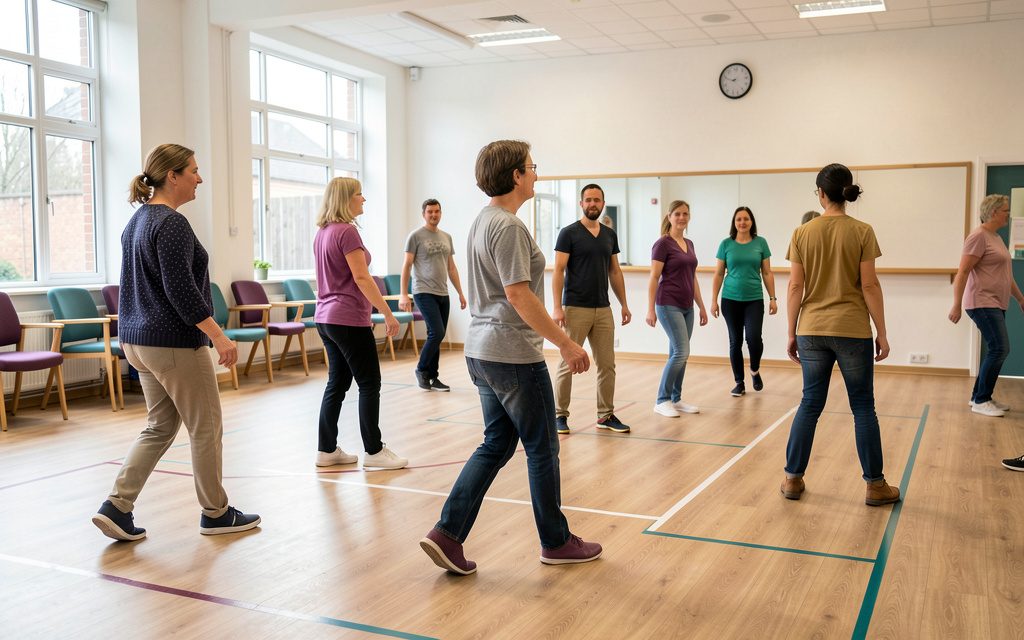
Dance steps come in families because the body only moves in a small number of ways, and every named step is a variation on one of them. A family groups those variations under one heading, so a new step is learned as a change to something you already own rather than as a fresh item in a long list. An alphabetical list tells you where a word sits; a family tells you what your feet are doing.
Why do dance steps come in families?
A step family is a group of movements that share the same travel, the same weight change and the same timing shape. The vine family travels sideways, crosses once, and lands on the same foot pattern every time. The shuffle family stays in place and replaces weight twice. The turn family rotates the body while the feet keep a known sequence underneath.
Teachers group steps this way because the body remembers patterns, not labels. Once a dancer knows the shape of a vine, a rolling vine is a vine with a turn added, and a grapevine with a hitch is a vine with one beat changed. The learner is not starting from nothing. The learner is adjusting a shape that already works.
Classification is not a dance idea. Any field that collects many examples builds families so that a stranger can recognise one example later. A museum catalogue does the same thing with objects, and a reader who wants to see how that is done can look at how European sword types are classified, where blades are sorted by hilt and proportion rather than by name alone. The principle carries across: the family describes the object, and the name is only a handle.
A family also survives translation. Two halls in different towns may use different words for the same action, but if both teachers describe the family first, the dancer can place the step before the name arrives.
How does a named family make a new step easier to learn?
A named family gives the new step a home before you can perform it. When a teacher says the new step belongs to the coaster family, you already know four things: the step travels backwards, the weight changes on the same beat, the free foot does the work, and the body stays square. Only the detail is new.
This is why experienced teachers introduce a step by its relatives. They say it is like a step you know, but the turn comes earlier, or the touch replaces the step. The learner hears one difference instead of a whole description. One difference is learnable in a few repetitions. A full description takes much longer.
A family also gives you a place to put the step when the music changes. If the tempo rises, you can drop to the simplest member of the family and keep dancing. If the tempo falls, you can add the variation back. The family holds the options, and the dancer chooses the level.
The same logic applies to counts and walls. A step family sits inside the count structure, so a new step does not disturb the wall pattern. You place it where the family already sits, and the rest of the dance stays intact.
How is a new step placed beside the ones already known?
Placement happens in three checks. First, the travel: does the step move forward, back, sideways or in place? Second, the weight: which foot takes the weight, and on which count? Third, the shape: does the body turn, and if so, how far?
Run those three checks and the new step lands in a family almost by itself. A step that travels sideways with a cross belongs with the vines. A step that stays in place with two quick weight changes belongs with the shuffles. A step that turns a quarter while travelling forward belongs with the turning walks.
Teachers often write the family name in the stepsheet margin, not the step name. That margin note is what the dancer reads at speed. The full name is useful once, at the teach. The family is what carries the step into the next social.
A useful habit is to keep a personal page per family rather than per step. Add the new step under its family heading with one line about what makes it different. Over a year, that page becomes a map of your own vocabulary, and the map is shorter than any alphabetical list you could write.
What happens when two teachers use different names for the same action?
Different names for one action are normal, and they are not a sign that one teacher is wrong. Regional habits, older syllabi and plain preference all produce several names for the same movement. The action is what matters, and the family is the common ground.
When two names meet, ask for the family and the counts. If both teachers describe a sideways travel with a cross on count two, the step is the same, whatever it is called. The name is a label on the box. The family is the shape of the box.
This is where a written record helps. A stepsheet that lists the family, the counts and the direction survives a change of teacher. A stepsheet that lists only a name does not. When you learn from a video with no notes, write the family down yourself before you forget the shape.
The same care applies to any collection of named things. A register that records the family, the material and the proportion can be read by someone who has never met the original object, and a register that records only a name cannot. That is the whole point of a classification scheme: it lets a stranger recognise one example later, in a different room, from a different teacher, on a different night.
A short vocabulary beats a long list
A dancer who knows eight families can meet a new step and place it in seconds. A dancer who knows eighty step names in alphabetical order has to search the whole list every time. The families are the vocabulary. The names are the entries.
Start with the families you already dance. Name them in your own words, then add the steps you know under each heading. When a new step arrives, run the three checks and file it. When a teacher uses an unfamiliar name, ask for the family and the counts, then file it beside the step you already have.
The result is a small, stable map that grows slowly and stays readable. It is the same reason a museum sorts its blades by hilt and proportion rather than by the order they arrived, and the same reason a stepsheet sorts its steps by wall and count rather than by the alphabet. The map is what lets you recognise the next example, and recognition is what makes the next step easy to learn.
01
Notice the pattern
Dance steps come in families because the body only moves in a small number of ways, and every named step is a variation on one of them. That is why the useful question is not whether you look like everyone else. It is whether you can describe the next action in a way that lets you repeat it. A step sheet may use a compact token, while a teacher may use a spoken cue. The Step Decoder keeps both close to the physical action.
02
Try one clean version
A family groups those variations under one heading, so a new step is learned as a change to something you already own rather than as a fresh item in a long list. Begin at a pace that allows you to hear your own count. Keep enough clear space to stop, reset and begin again. If a local instructor gives a different convention, their room-specific direction wins for that class.
03
Check the next foot
Before moving on, pause and identify your facing direction, supporting foot and next count. This is a better self-check than rushing through a longer sequence. It also makes the weight-transfer guide useful even when the term first feels technical.
For a first class, pair this page with what to expect in the room. For home practice, use the four-week practice route to keep the next decision manageable.
Source consulted for this note: bl.uk.
Sources and scope
Source note: terminology and level guidance are compared with Linedancer, CLDAA, Kickish and canonical step-sheet metadata. Wording here is an original explanation.
Last reviewed 16 September 2026. Read the full method and sources, or email a terminology correction to [email protected].