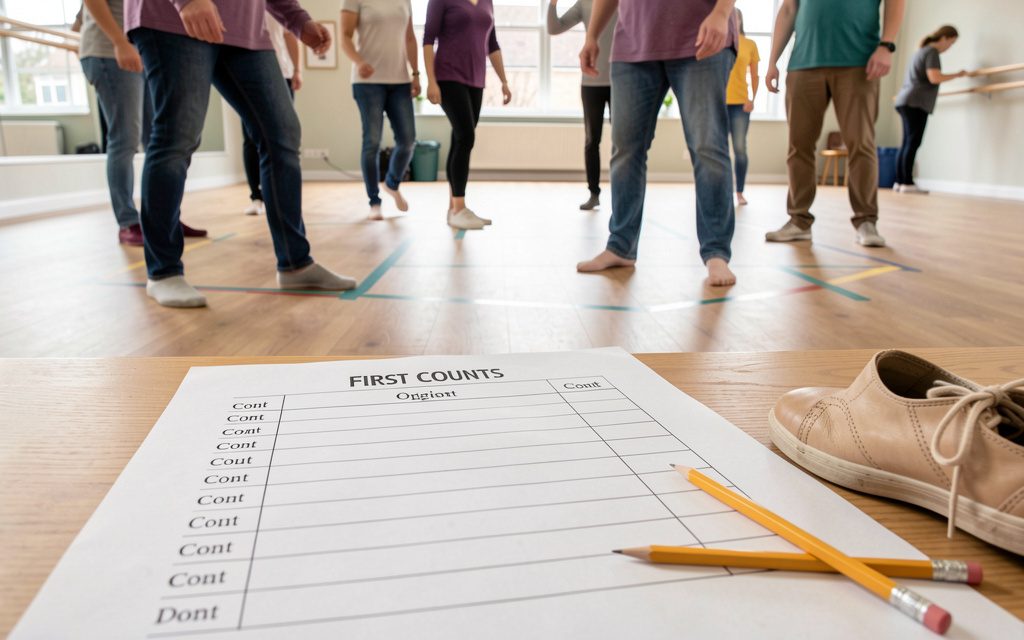
A step sheet cannot tell you how a room actually dances. It records counts, walls, tags and restarts, but it leaves out the weight of a step, the size of a movement and the small adjustments a teacher makes on the night. The document is a map, and the class is the ground it describes.
That gap is not a fault. It is the reason dancers keep the sheet in one hand and the room in the other. The same habit appears in other fields where a text and a living practice sit side by side, as with reading Lincoln's own texts alongside the communities that first heard them. A written record holds its shape, and the people who use it decide what it means on the day.
What can a written step sheet not tell you?
A step sheet cannot tell you how big a step should be. It gives you the count and the direction, and nothing about the distance. Two teachers can read the same eight counts and produce a travelling step that crosses the floor and a compact one that barely moves. Both are correct readings of the same line.
It cannot tell you the weight of a step either. A shuffle written as two counts can land flat or light, and the sheet has no notation for that. Weight is carried in the body, passed on by demonstration and corrected by eye.
Timing within a count is another gap. A sheet says one and two, and the room decides whether the and sits early, late or square. In a hall with a live caller the timing breathes with the music, and the paper version stays fixed.
Style is the largest absence. Arm styling, hip movement, the angle of a turn and the way a dancer settles after a coaster step are all learned by watching. A sheet can name a step and cannot show its texture.
Floorcraft is missing too. A sheet does not tell you how much space to leave, how to pass another couple or where to stand when the room is full. Those are social skills, learned in the room and adjusted to the number of people present.
Finally, a sheet cannot tell you what the class already knows. A group that has danced a routine for a year carries a shared memory of small fixes. A newcomer reading the same sheet sees only the counts, and the difference is not in the document.
How do you weigh a source that disagrees with the room?
Start by asking what kind of source it is. A step sheet is a record of an intention, often written by the choreographer or a nominated scribe. A class is a record of a practice, shaped by a teacher and a room. They answer different questions, so a disagreement is not automatically an error.
Check the version. Many routines exist in more than one sheet, and a later revision may add a tag, change a wall or move a restart. If the class is dancing a version that differs from your paper, the paper may simply be older. Look for a date, a revision note or a named source at the top of the page.
Check the level. A sheet written for improver dancers may simplify a turn that an advanced class performs in full. The same routine can be taught at two levels without either being wrong.
Ask the teacher, and ask at the right moment. A question between dances is welcome. A question in the middle of a walk-through interrupts the room. Most teachers will explain a change if you ask after the run-through, and many will show you the sheet they work from.
Hold your reading lightly. If the room does something different from your sheet for several weeks, the room is probably right for that class. Keep the sheet as a reference and let the practice lead.
Write your own notes in the margin. A pencil mark next to a count, a small arrow for a turn, a note that the class restarts after wall four: these turn a generic sheet into a personal record. The document becomes more useful when it carries what the room taught you.
What the record keeps open
The value of a written notation is that it keeps a correction channel open. A sheet can be checked, compared, dated and corrected. Without it, a routine lives only in memory, and memory drifts.
A sheet also lets a dancer who missed a week catch up. It gives a shared vocabulary for a question: not I think it goes left, but the sheet says wall three. That turns a disagreement into something the class can examine together.
It also protects a beginner from guessing. A new dancer can read the counts at home, arrive with a rough shape and use the class to fill in the rest. The sheet does the remembering, and the room does the teaching.
Why a document is read alongside the people who use it
A document is read alongside people because meaning is settled in use. The same text can support a careful reading and a careless one, and the community around it decides which reading holds. This is true of dance sheets, of legal texts and of historical documents.
In each case the reader brings a question and the group brings a check. A claim that cannot survive the room is revised, and a claim that survives becomes part of the practice. The document stays the same and the reading matures.
That is why teachers keep a sheet visible and still demonstrate. The paper carries the structure, and the demonstration carries the life. Neither replaces the other, and a class that uses both learns faster than one that uses only one.
How to use a sheet in a beginner class
Read the sheet before the class, not during it. Ten minutes at home gives you the shape of the routine and the names of the walls. Arrive ready to watch rather than to decode.
Mark the parts you do not understand and ask about one of them. A single clear question is more useful than a list, and it respects the teacher's time.
Dance the counts you know and let the rest pass. A beginner who stops at every unfamiliar step slows the room. Keep moving, and the gaps fill in over weeks.
Compare your sheet with the teacher's after class. If they differ, ask which version the class is using and note it on your copy. That single note prevents weeks of quiet confusion.
Keep a small notebook for corrections. Write the date, the wall and the change. Over a season you build a personal record that no published sheet can match, because it describes the class you actually attend.
The limits are the point
A written notation is useful precisely because it is limited. It fixes what can be fixed and leaves the rest to the room. A dancer who understands that limit reads a sheet with more patience and dances with more attention.
The record keeps the correction channel open. The room keeps the record honest. A beginner who holds both learns the routine and learns how to learn, which is the more durable skill.
01
Notice the pattern
A step sheet cannot tell you how a room actually dances. That is why the useful question is not whether you look like everyone else. It is whether you can describe the next action in a way that lets you repeat it. A step sheet may use a compact token, while a teacher may use a spoken cue. The Step Decoder keeps both close to the physical action.
02
Try one clean version
It records counts, walls, tags and restarts, but it leaves out the weight of a step, the size of a movement and the small adjustments a teacher makes on the night. Begin at a pace that allows you to hear your own count. Keep enough clear space to stop, reset and begin again. If a local instructor gives a different convention, their room-specific direction wins for that class.
03
Check the next foot
Before moving on, pause and identify your facing direction, supporting foot and next count. This is a better self-check than rushing through a longer sequence. It also makes the weight-transfer guide useful even when the term first feels technical.
For a first class, pair this page with what to expect in the room. For home practice, use the four-week practice route to keep the next decision manageable.
Source consulted for this note: nps.gov.
Sources and scope
Source note: terminology and level guidance are compared with Linedancer, CLDAA, Kickish and canonical step-sheet metadata. Wording here is an original explanation.
Last reviewed 16 September 2026. Read the full method and sources, or email a terminology correction to [email protected].