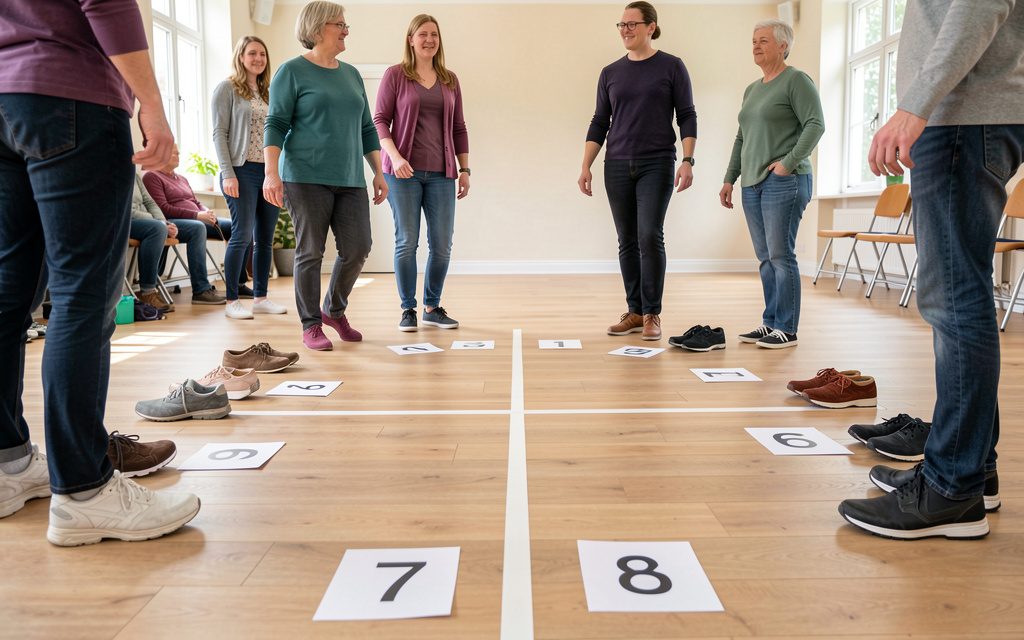
A field mark is a small visible signal that tells you what a step is asking for. In line dance it is the foot that carries the weight, the direction the body faces and the count on which the movement lands. Read those three marks and a step stops being a shape you copy and becomes a sentence you can follow.
The habit comes from field guides, where a bird or a fish is named by a few reliable features rather than by its whole outline. Anglers on the Niagara River use the same habit, and a guide such as smallmouth bass, identification, Niagara River works because it points to marks you can check in poor light. A dance floor is poor light too. Bodies overlap, music covers the count and the person in front turns the wrong way. Marks survive that.
Which marks tell you what a step is asking for?
Start with weight. At any moment one foot holds you and the other is free. The free foot is the one that can move, so the free foot tells you what comes next. If the free foot is beside the weighted foot, the step is likely a touch, a tap or a hold. If it is behind, the step is likely a rock or a coaster. If it is lifted, the step is a step or a hitch. You do not need the whole pattern to read this. You need one glance at the ankles.
Direction is the second mark. The body faces a wall, a corner or a diagonal, and that facing is the wall the step is travelling towards. A step that turns shows its direction in the shoulders before the feet arrive. Watch the leading shoulder: it opens towards the new wall a beat early. A step that stays on the spot keeps the shoulders square to the same wall throughout.
The count is the third mark. Counts are not evenly loud. In a step that uses a syncopation, the quick movement is smaller and lower than the slow one. The slow count takes a full weight change and a visible settle. The quick count is a passing touch, often on the ball of the foot. If you see a large movement where the count is quick, you are reading the wrong mark, and the step will feel rushed.
A fourth mark is the hand. Hands are not decoration. A hand that rises with the free foot marks a turn or a sweep. A hand held low and still marks a travelling step. A hand that crosses the body marks a step that closes rather than opens. Beginners often copy the arms last, but the arms are the easiest mark to see from the back of a hall.
How do you tell two similar steps apart?
Two steps can share a name, a rhythm and a starting foot and still be different steps. The difference sits in one mark, and finding that mark is the whole skill.
Take a vine and a rolling vine. Both travel sideways and both use three counts with a touch on the fourth. The vine keeps the body facing the same wall for the whole pattern. The rolling vine turns the body a quarter on each of the first two counts, so the shoulders pass through two walls before the touch. If you watch only the feet, the two look identical. If you watch the shoulders, they separate at once.
Take a shuffle and a chasse. Both are quick, both move sideways and both use a count of and. The shuffle keeps the weight low and the feet close, and the movement is a slide rather than a lift. The chasse lifts the free foot slightly and places it, so there is a small gap under the sole. From across a busy floor the gap is the mark. Look at the floor under the moving foot, not at the foot itself.
Take a rock step and a coaster step. Both go back and forward on two counts. The rock step keeps the weight on the back foot for the whole of the first count and returns on the second. The coaster step puts the weight down on the back foot and then closes the free foot beside it before the forward movement. The mark is the closing foot. If a foot passes beside the weighted foot, it is a coaster. If no foot passes, it is a rock.
Take a pivot turn and a spiral turn. Both change the facing wall. The pivot keeps both feet in contact with the floor and turns on the balls. The spiral lifts the free foot and carries it around the body. The mark is the floor contact. A heel that stays down marks a pivot. A heel that rises and travels marks a spiral.
How a written mark and an observed mark are checked against each other
A stepsheet is a written mark. It names the foot, the direction and the count in words and numbers. A dancer on the floor is an observed mark. The two should agree, and when they do not, one of them is being read wrongly.
The check runs in one direction. Read the stepsheet line for the count you are on, then look at the free foot of a dancer who knows the dance. If the stepsheet says right and the free foot is the left, you have misread the sheet, not the dancer. If the stepsheet says forward and the shoulders are opening to a new wall, the step includes a turn the sheet has written as a direction change.
This is the same discipline a field guide asks for. You do not identify a fish from memory of its outline. You check a mark, then check it again against a second mark. A written mark and an observed mark that agree are worth more than either alone.
Reading marks at the back of a busy floor
Distance changes which marks are available. At the front of a class you can see feet. At the back you cannot, so you read higher up the body. Shoulders give direction. Hips give weight. The head gives the count, because a dancer who is sure of the count nods slightly on the slow beat.
Choose one dancer and stay with them for a whole wall. Do not scan the room. A single reliable body gives you a continuous mark, and continuity is what turns marks into a pattern. When that dancer leaves the floor, choose another and start again.
Use the music as a written mark too. Most line dance tracks have a clear phrase of thirty two counts, and the phrase restarts on a wall change. If you lose the count, listen for the phrase rather than watching for the step. The phrase will put you back on the right wall without any footwork at all.
Practice that makes marks stick
Pick two steps you confuse and write down the one mark that separates them. Do not write the whole pattern. Write the shoulder, the closing foot or the floor contact. Then dance both steps slowly and say the mark out loud as it happens. The word and the movement arrive together, and the pair becomes a single memory.
Repeat this with three pairs over a month. The aim is not to collect steps. The aim is to build a small set of marks you trust, so that a new step can be read rather than memorised. Dancers who learn quickly are not remembering more. They are reading better.
Finally, check your own marks. Ask someone to watch you dance a step you know well and tell you which foot is free on count three. Their answer is an observed mark of your own dancing, and it is often the first honest report you get.
01
Notice the pattern
A field mark is a small visible signal that tells you what a step is asking for. That is why the useful question is not whether you look like everyone else. It is whether you can describe the next action in a way that lets you repeat it. A step sheet may use a compact token, while a teacher may use a spoken cue. The Step Decoder keeps both close to the physical action.
02
Try one clean version
In line dance it is the foot that carries the weight, the direction the body faces and the count on which the movement lands. Begin at a pace that allows you to hear your own count. Keep enough clear space to stop, reset and begin again. If a local instructor gives a different convention, their room-specific direction wins for that class.
03
Check the next foot
Before moving on, pause and identify your facing direction, supporting foot and next count. This is a better self-check than rushing through a longer sequence. It also makes the weight-transfer guide useful even when the term first feels technical.
For a first class, pair this page with what to expect in the room. For home practice, use the four-week practice route to keep the next decision manageable.
Source consulted for this note: niagaraparks.com.
When you read the marks of a step, the marks often repeat in small groups. A shuffle, a coaster and a kick ball change share the same weight change, so the marks look alike on the sheet. That is why placing a step in a family helps you learn it faster: you already know the shape from another dance. The page How Dance Steps Come in Families at 1ststepslinedance.com explains this idea in plain terms, and you can open it here: placing a step in a family. Read the marks first, then ask which family the step belongs to. The answer usually names a step you have already danced.Sources and scope
Source note: terminology and level guidance are compared with Linedancer, CLDAA, Kickish and canonical step-sheet metadata. Wording here is an original explanation.
Last reviewed 16 September 2026. Read the full method and sources, or email a terminology correction to [email protected].