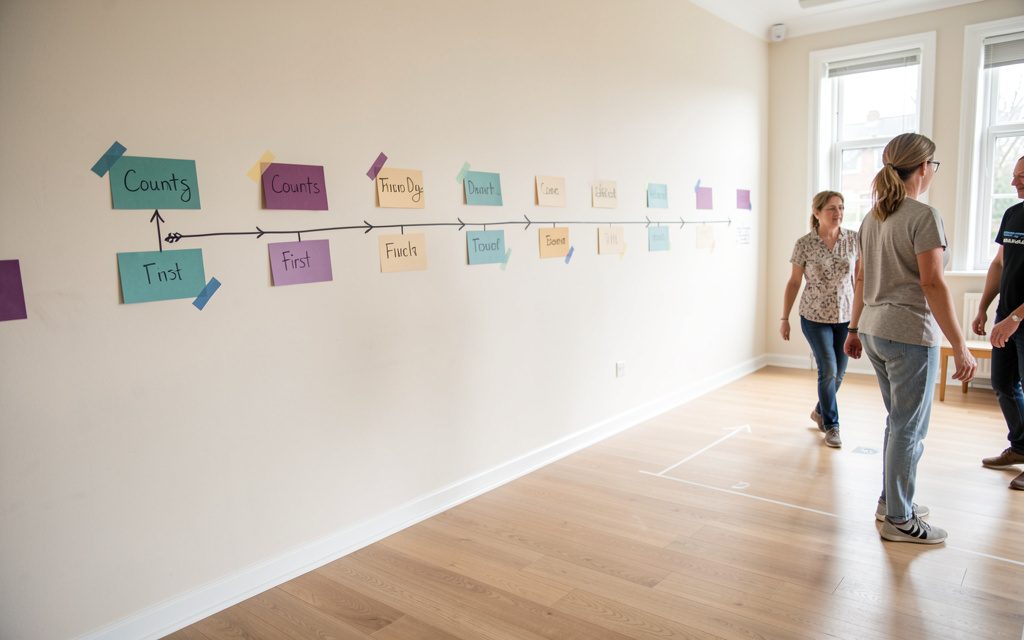
Counting helps you remember a sequence because it turns a long string of movements into a small number of equal pieces, and the mind holds a few equal pieces far better than one long list. An eight-count phrase gives you a shape you can carry: you do not need to recall every step name in order, only the phrase and its place in the wall. A short written form works the same way, which is why how a short poem counts is worth a look if you want to see counting used as a memory device outside the hall.
Why does counting help you remember a sequence?
A sequence of thirty or forty movements is too much to hold as a single item. Counting breaks it into chunks of eight, and each chunk becomes one thing to remember rather than eight. This is the same principle that makes a phone number easier as three groups than as eleven digits. The count is not decoration. It is the structure that lets the memory do less work.
In line dance the count also carries the timing. When you say the counts out loud, you are marking both the step and the beat, so the movement and the music are stored together. Dancers who learn by count often find that the music alone brings the phrase back, because the two were never separated in memory. A dancer who learns only from a list of step names has to rebuild the timing every time, and that rebuilding is where the sequence falls apart.
The count also gives you a way to check yourself. If you lose the phrase, you can return to the nearest count of eight and start again from there. A list of names offers no such handhold. You either remember the whole list or you do not. The count gives you a ladder with rungs, and a ladder is easier to climb than a rope.
There is a further point about the body. Counting aloud or silently gives the feet something to follow, and the voice and the feet reinforce each other. This is why teachers count through a new sequence before they name any of the steps. The count comes first because the count is what the body keeps.
What makes a short form easier to hold in memory?
A short form is easier to hold because it has a fixed shape and a small number of parts. Eight counts is a shape. Six lines is a shape. Once the shape is known, the content can be recalled by position: the first part, the second part, the turn, the close. The shape does the organising, and the mind only has to fill the slots.
Short forms also leave out what does not carry weight. A poem of six lines cannot afford a wasted word, and a phrase of eight counts cannot afford a wasted step. The pressure of the small frame forces each part to do a job. What remains is denser and therefore easier to keep. Long forms allow padding, and padding is what the memory drops first.
A short form is also easier to repeat. Repetition is how memory is built, and a form that takes ten seconds to run through will be repeated far more often than one that takes two minutes. The dancer who can run a phrase in the time it takes to wait for a kettle to boil will practise it many times a day without noticing. The length of the form decides how often it is used, and use decides what is remembered.
Finally, a short form can be written down in a way that fits on one page or one card. The written version is not the memory itself, but it is a support for the memory, and a support that fits in a pocket gets consulted. A long sequence written out in full is a document. A short form written out is a note, and notes get carried.
How does a count cut a long sequence into pieces small enough to carry?
The cut is the whole trick. A wall of thirty-two counts is not remembered as thirty-two. It is remembered as four phrases of eight, and each phrase is remembered as a shape with a beginning, a middle and an end. The dancer who knows the four phrases can rebuild the wall even after a mistake, because the phrases are separate objects that can be picked up again.
The cut also tells you where to breathe. In a long sequence there is no natural resting place, and the dancer who tries to hold the whole thing in one go will tire and lose it. The count of eight provides a small pause, a place to reset the feet and the attention. That pause is not a gap in the dance. It is part of the structure, and it is what makes the next phrase possible.
Teachers use this when they teach a new dance. They do not teach thirty-two counts. They teach eight, then eight more, then join them. The joining is easier than the learning because the pieces are already secure. The same method works when you learn from a stepsheet at home. Take one phrase, count it through until it is solid, then add the next. The count is the unit of work.
What does a short written form teach about the pause between the pieces?
A short written form teaches that the pause is not empty. In a poem of a few lines, the break between stanzas carries as much as the lines themselves. The reader stops, and in that stop the previous lines settle. The same happens between phrases of eight in a dance. The pause at the end of a phrase is where the phrase is stored.
Writers on short forms often speak of the turn, the point where the poem changes direction. A dance phrase has a turn too, usually at the end of the eight, where the weight shifts and the next phrase begins. Recognising the turn helps the dancer because it marks the boundary between one piece and the next. Without the boundary, the phrases run together and the memory has nothing to grip.
The written form also shows that a pause can be marked. A line break, a stanza break, a comma: each is a signal to stop for a moment. In dance the signal is the count itself, spoken or felt. The dancer who marks the pause is doing what the poet does on the page. Both are using a small silence to make the next part easier to hold.
This is why a stepsheet with clear phrase breaks is easier to learn from than one written as a continuous block. The breaks are information. They tell you where the pieces end, and where the memory can rest before it takes up the next piece.
How counting turns a list into a shape
A list of step names is flat. It has no shape, no rhythm and no obvious place to stop. A count gives the list a shape: eight counts, then eight more, then a turn, then home. Once the shape is known, the names matter less. Many experienced dancers can perform a dance they cannot name step by step, because they hold the shape rather than the list.
This is the practical lesson for anyone learning from a stepsheet. Read the counts before you read the names. Count the phrase through with your feet before you worry about what each step is called. The count will carry you further than the vocabulary, and it will stay with you longer.
The same is true of any short form. The shape is the memory. The content fills the shape, and the pause between the pieces is what keeps the shape visible. A dancer who counts is not just keeping time. A dancer who counts is building a structure that the body can hold, one small piece at a time.
01
Notice the pattern
Counting helps you remember a sequence because it turns a long string of movements into a small number of equal pieces, and the mind holds a few equal pieces far better than one long list. That is why the useful question is not whether you look like everyone else. It is whether you can describe the next action in a way that lets you repeat it. A step sheet may use a compact token, while a teacher may use a spoken cue. The Step Decoder keeps both close to the physical action.
02
Try one clean version
An eight-count phrase gives you a shape you can carry: you do not need to recall every step name in order, only the phrase and its place in the wall. Begin at a pace that allows you to hear your own count. Keep enough clear space to stop, reset and begin again. If a local instructor gives a different convention, their room-specific direction wins for that class.
03
Check the next foot
Before moving on, pause and identify your facing direction, supporting foot and next count. This is a better self-check than rushing through a longer sequence. It also makes the weight-transfer guide useful even when the term first feels technical.
For a first class, pair this page with what to expect in the room. For home practice, use the four-week practice route to keep the next decision manageable.
Source consulted for this note: archives.gov.
Sources and scope
Source note: terminology and level guidance are compared with Linedancer, CLDAA, Kickish and canonical step-sheet metadata. Wording here is an original explanation.
Last reviewed 16 September 2026. Read the full method and sources, or email a terminology correction to [email protected].