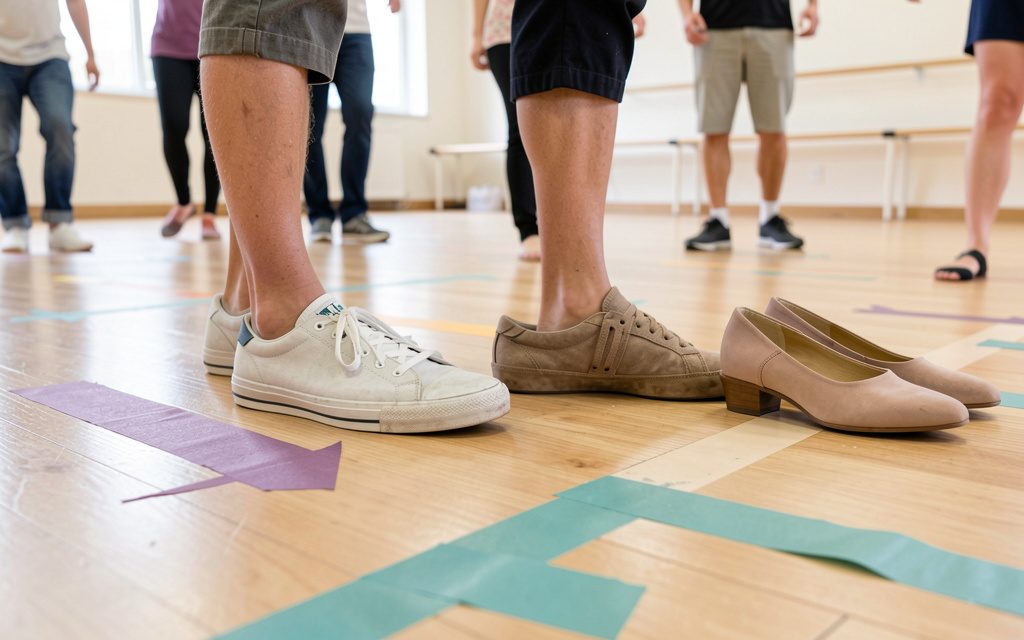
A room knows what comes next because one signal arrives before the movement does. A call names the figure, a cue marks the moment, and a sounded signal carries across noise that a spoken sentence cannot cross. Dancers learn a small shared set of these, then stop listening for words and start listening for shape.
How does a room know what comes next?
A room knows what comes next through anticipation, not through volume. The signal arrives slightly before the first step, so the body has time to prepare. In a hall of forty people, the teacher cannot explain each figure again. The signal has to do the explaining.
Three things make that work. The signal is short. The signal is the same every time. The signal comes early enough to be acted on rather than merely heard.
Shortness matters because a floor is full of delay. Sound reaches the back of the hall a fraction after the front, and people at the back are already watching the people ahead of them. A long sentence arrives in pieces. A two beat signal arrives whole.
Sameness matters because recognition is faster than understanding. Once a group has heard the same opening four times, the fourth hearing needs no thought. The dancers are not decoding the signal. They are recognising it, the way a driver recognises a road sign without reading it.
Timing matters because preparation is physical. A weight shift needs a moment. If the signal lands on the beat where the step happens, the step is late. If it lands a beat before, the step is ready.
This is also why a caller or teacher watches the floor rather than the music. The useful information is not in the count. It is in how many people have already turned their heads.
A sounded signal does something a sentence cannot. In a hall with a wooden floor, a band in the corner and a hundred conversations, the human voice loses its edges. A horn, a whistle or a struck instrument keeps its shape at distance. This is not a musical trick. It is a practical one, and it is old. Long before dance halls, outdoor work used sounded signals for exactly this reason, and anyone curious about how a single instrument can carry a whole set of instructions can look at the signals a hunting horn plays to see the same principle written down as a repertoire.
What is the difference between a call and a cue?
A call tells you what to do. A cue tells you when to do it.
The call is the name of the figure. It is the content. In a walkthrough, the teacher says the name, the dancers walk it, and the name becomes attached to the movement. The call is information you could write down.
The cue is the moment. It is the timing. A cue can be a word, a breath, a lifted hand, a nod, a single note. It carries no new information about the figure. It carries the instruction to begin the figure you already know.
This distinction explains a common beginner problem. A new dancer hears the call and starts thinking about the steps. By the time the thinking finishes, the cue has passed. The figure is known but the moment is gone. Experienced dancers reverse the order. They hear the call as a warning, hold the shape, and wait for the cue to release them.
A cue is also more portable than a call. A teacher can cue with a hand when the music is loud, with a nod when the room is quiet, with a raised finger when the floor is spread out. The cue adapts to the room. The call does not, because the call has to stay the same for the group to keep recognising it.
There is a third element, the count. A count is neither call nor cue. It is the shared grid that both sit on. Counts tell the group where they are in the phrase. Without a count, a call has no address and a cue has no anchor.
Why a signal reaches a crowded floor when a sentence does not
A spoken sentence is a sequence. It needs the beginning, the middle and the end to arrive in order. A crowded room breaks sequences. Laughter, a dropped bottle, a door, a latecomer, all of these cut the sentence into fragments.
A signal is a shape. It can be recognised from a fragment. A single note, a raised arm, a sharp clap, each of these carries the whole message in one piece. The ear or the eye does not need the rest of it.
Signals also survive distance better than speech. Speech depends on consonants, and consonants are the first thing a large room takes away. Sounded signals depend on pitch and rhythm, which travel further and stay distinct. This is why a caller with a voice alone will often add a hand, and why a teacher with a large hall will often add an instrument.
There is a social effect too. A signal is visible to everyone at once. A sentence is aimed at whoever is nearest. When the whole floor sees the same raised hand, the group moves as one body rather than as forty individuals reacting at different speeds.
How a group learns a shared set of signals
A group learns signals by repetition in context, not by explanation. Nobody memorises a list. The list is built by hearing the same short sound at the same point in the same figure, week after week, until the sound and the movement become one thing.
A useful teaching order looks like this. First, the figure is walked slowly with the name spoken aloud. Second, the name is shortened to a single word. Third, the word is replaced by a gesture or a note. Fourth, the gesture is used at full speed with the music. Each stage removes a little more language and leaves a little more signal.
Groups also need a small vocabulary. Ten to fifteen signals cover most of a beginner set. More than that and the group spends its attention on remembering signals instead of dancing. A small set used consistently beats a large set used loosely.
It helps to agree on the physical form of each signal. A cue that is sometimes a nod and sometimes a hand is two cues, and the group has to learn both. A cue that is always the same hand at the same height is one cue, and it becomes invisible in the best sense, noticed without effort.
Finally, a group learns signals by seeing them fail. When a cue arrives late and the floor stumbles, everyone in the room learns the timing. Mistakes are part of the vocabulary. They show the group where the signal sits in the phrase.
Signals, calls and cues in a beginner class
A beginner class can run with three tools. A spoken call for the name of the figure. A physical cue for the moment of the start. A count for the position in the phrase.
Keep the call clear and unchanging. Keep the cue early and consistent. Keep the count simple, usually to eight, and say it aloud until the group stops needing it.
When the room is large, replace the voice with a sound that carries. When the room is small, a hand is enough. The principle does not change. The signal has to arrive before the movement, and it has to arrive in one piece.
A dancer who understands this stops waiting to be told and starts reading the room. That is the point at which a class becomes a group.
01
Notice the pattern
A room knows what comes next because one signal arrives before the movement does. That is why the useful question is not whether you look like everyone else. It is whether you can describe the next action in a way that lets you repeat it. A step sheet may use a compact token, while a teacher may use a spoken cue. The Step Decoder keeps both close to the physical action.
02
Try one clean version
A call names the figure, a cue marks the moment, and a sounded signal carries across noise that a spoken sentence cannot cross. Begin at a pace that allows you to hear your own count. Keep enough clear space to stop, reset and begin again. If a local instructor gives a different convention, their room-specific direction wins for that class.
03
Check the next foot
Before moving on, pause and identify your facing direction, supporting foot and next count. This is a better self-check than rushing through a longer sequence. It also makes the weight-transfer guide useful even when the term first feels technical.
For a first class, pair this page with what to expect in the room. For home practice, use the four-week practice route to keep the next decision manageable.
Source consulted for this note: blasmusikverband.de.
A caller's cue only works if the dancer can hold the phrase long enough to act on it. When a hall falls quiet and the next call comes, the dancers who recover fastest are usually the ones who have already counted the section in their head, so the signal lands on a beat they expected rather than a surprise. That habit is worth building away from the floor, and the guide on why counting helps you remember a dance explains how carrying a phrase by its count turns a shouted cue into a step you can place without hesitation.Sources and scope
Source note: terminology and level guidance are compared with Linedancer, CLDAA, Kickish and canonical step-sheet metadata. Wording here is an original explanation.
Last reviewed 16 September 2026. Read the full method and sources, or email a terminology correction to [email protected].